Ch. 19 - Amines
Wade - Organic Chemistry 9th Edition
Wade9th EditionOrganic ChemistryISBN: 9780135213728당신이 사용하는 게 아니라요?교과서 변경
19장, 문제 31d

Show how to prepare the following aromatic amines by aromatic nitration, followed by reduction. You may use benzene and toluene as your aromatic starting materials.
(d) m-aminobenzoic acid

검증된 단계별 안내
1
Step 1: Begin with the appropriate aromatic starting material. In this case, use toluene as the starting material since it contains a methyl group that can direct incoming substituents to the ortho and para positions.
Step 2: Perform an aromatic nitration reaction on toluene. Use a mixture of concentrated HNO₃ (nitric acid) and concentrated H₂SO₄ (sulfuric acid) to introduce a nitro group (-NO₂) onto the aromatic ring. The methyl group on toluene will direct the nitro group to the ortho and para positions, but you will also obtain some meta product. Separate and isolate the meta-nitrotoluene product.
Step 3: Oxidize the methyl group of meta-nitrotoluene to a carboxylic acid group (-COOH). This can be achieved using a strong oxidizing agent such as KMnO₄ (potassium permanganate) under acidic or basic conditions. The product will be m-nitrobenzoic acid.
Step 4: Reduce the nitro group (-NO₂) in m-nitrobenzoic acid to an amino group (-NH₂). This can be done using a reducing agent such as Sn (tin) and HCl (hydrochloric acid), or alternatively, catalytic hydrogenation (H₂ with a metal catalyst like Pd/C). The product will be m-aminobenzoic acid.
Step 5: Purify the final product, m-aminobenzoic acid, by recrystallization or another appropriate purification method to ensure the desired compound is obtained in high purity.

비슷한 문제에 대한 검증된 영상 답변:

이 영상 해법은 위 문제에 도움이 된다고 튜터들이 추천한 것입니다.
영상 길이:
2m
도움이 되었나요?

주요 개념

질문에 올바르게 답하기 위해 반드시 이해해야 하는 핵심 개념들은 다음과 같습니다.

Aromatic Nitration

Aromatic nitration is a chemical reaction that introduces a nitro group (-NO2) into an aromatic compound, typically using a mixture of concentrated nitric acid and sulfuric acid. This electrophilic substitution reaction is crucial for preparing aromatic amines, as it allows for the functionalization of the aromatic ring, which can then be further modified through reduction.
추천 영상:
08:19
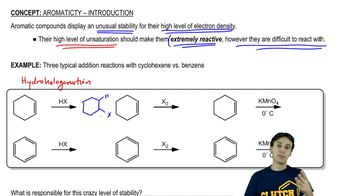
Intro to Aromaticity

Reduction of Nitro Compounds

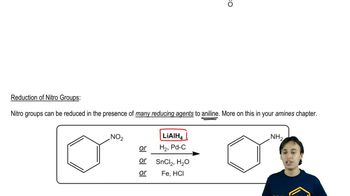
The reduction of nitro compounds involves converting the nitro group (-NO2) into an amine group (-NH2). This can be achieved using various reducing agents, such as iron and hydrochloric acid or catalytic hydrogenation. This step is essential for transforming the nitrated aromatic compound into the desired aromatic amine, such as m-aminobenzoic acid.
추천 영상:
03:23
Reduction of Nitro Groups

Ortho/Para vs. Meta Directing Effects

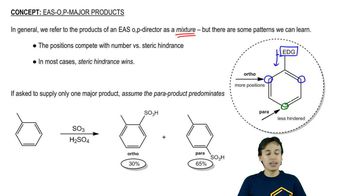
In electrophilic aromatic substitution reactions, substituents on the aromatic ring can influence the position of new substituents. Electron-donating groups, like amines, direct incoming electrophiles to the ortho and para positions, while electron-withdrawing groups, like nitro groups, direct them to the meta position. Understanding these directing effects is vital for predicting the product distribution in the synthesis of m-aminobenzoic acid.
추천 영상:
04:42
Ortho, Para major products