
Ch. 19 - Amines
Wade - Organic Chemistry 9th Edition
Wade9th EditionOrganic ChemistryISBN: 9780135213728당신이 사용하는 게 아니라요?교과서 변경
19장, 문제 49b

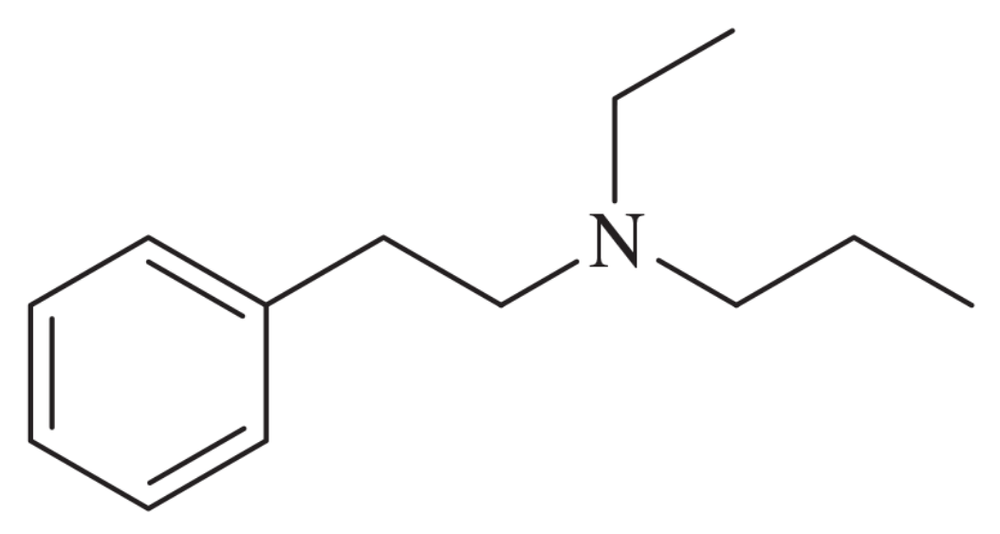
Show how you can synthesize the following tertiary amine three different ways, each using a different secondary amine and adding the final substituent by (b) acylation–reduction (3 ways).

검증된 단계별 안내
1
Step 1: Identify the target molecule as a tertiary amine with three substituents: a benzyl group, an ethyl group, and a propyl group. The goal is to synthesize this molecule using acylation-reduction methods with three different secondary amines.
Step 2: First approach: Start with benzylamine (a secondary amine with a benzyl group). Perform acylation by reacting benzylamine with an ethyl acyl chloride (CH3CH2COCl) to form an amide. Then, reduce the amide using a reducing agent like LiAlH4 to yield the tertiary amine with benzyl, ethyl, and propyl substituents.
Step 3: Second approach: Start with ethylamine (a secondary amine with an ethyl group). Perform acylation by reacting ethylamine with benzyl acyl chloride (C6H5CH2COCl) to form an amide. Reduce the amide using LiAlH4 to yield the tertiary amine with benzyl, ethyl, and propyl substituents.
Step 4: Third approach: Start with propylamine (a secondary amine with a propyl group). Perform acylation by reacting propylamine with benzyl acyl chloride (C6H5CH2COCl) to form an amide. Reduce the amide using LiAlH4 to yield the tertiary amine with benzyl, ethyl, and propyl substituents.
Step 5: Ensure that the reaction conditions for acylation and reduction are optimized to prevent overreaction or side reactions. Verify the structure of the final product using spectroscopic methods like NMR or IR to confirm the synthesis of the desired tertiary amine.

비슷한 문제에 대한 검증된 영상 답변:

이 영상 해법은 위 문제에 도움이 된다고 튜터들이 추천한 것입니다.
영상 길이:
11m
도움이 되었나요?

주요 개념

질문에 올바르게 답하기 위해 반드시 이해해야 하는 핵심 개념들은 다음과 같습니다.

Tertiary Amines

Tertiary amines are organic compounds that contain a nitrogen atom bonded to three carbon-containing groups. They are typically synthesized from secondary amines through various reactions, including acylation followed by reduction. Understanding the structure and reactivity of tertiary amines is crucial for designing synthetic pathways in organic chemistry.
추천 영상:
01:57
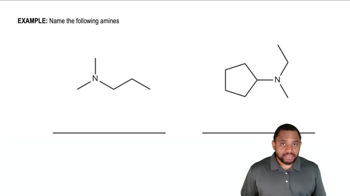
Naming Secondary and Tertiary Amines

Acylation

Acylation is a chemical reaction that introduces an acyl group (RCO-) into a molecule, often using acyl chlorides or anhydrides. In the context of amines, acylation converts amines into amides, which can then be reduced to form tertiary amines. This step is essential for modifying the amine structure and adding functional groups in synthetic organic chemistry.
추천 영상:
05:20
Friedel-Crafts Acylation

Reduction Reactions

Reduction reactions involve the gain of electrons or hydrogen, or the loss of oxygen, resulting in the conversion of a compound to a more saturated form. In the synthesis of tertiary amines, reduction typically follows acylation, where an amide is reduced to a tertiary amine using reducing agents like lithium aluminum hydride (LiAlH4) or catalytic hydrogenation. Understanding reduction mechanisms is vital for successful synthesis.
추천 영상:
07:12
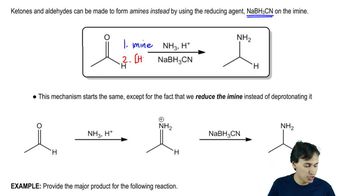
Reductive Amination
관련 실천
교과서 질문

Several additional amine syntheses are effectively limited to making primary amines. The reduction of azides and nitro compounds and the Gabriel synthesis leave the carbon chain unchanged. Formation and reduction of a nitrile adds one carbon atom. Show how these amine syntheses can be used for the following conversions.

(c) 1-bromo-3-phenylheptane → 3-phenylheptan-1-amine

852
views
교과서 질문

Several additional amine syntheses are effectively limited to making primary amines. The reduction of azides and nitro compounds and the Gabriel synthesis leave the carbon chain unchanged. Formation and reduction of a nitrile adds one carbon atom. Show how these amine syntheses can be used for the following conversions.

(a) allyl bromide → allylamine 

867
views
교과서 질문

Show how you can synthesize the following compounds starting with benzene, toluene, and alcohols containing no more than four carbon atoms as your organic starting materials. Assume that para is the major product (and separable from ortho) in ortho, para mixtures.

(b) N-methylbutan-1-amine

401
views
교과서 질문

Show how you can synthesize the following compounds starting with benzene, toluene, and alcohols containing no more than four carbon atoms as your organic starting materials. Assume that para is the major product (and separable from ortho) in ortho, para mixtures.

(c) N-ethyl-N-propylbutan-2-amine

638
views
교과서 질문

Show how you can synthesize the following compounds starting with benzene, toluene, and alcohols containing no more than four carbon atoms as your organic starting materials. Assume that para is the major product (and separable from ortho) in ortho, para mixtures.

(a) pentan-1-amine

584
views
교과서 질문

Show how you can synthesize the following tertiary amine three different ways, each using a different secondary amine and adding the final substituent by

(a) reductive amination (3 ways).

622
views