Ch. 19 - Amines
Wade - Organic Chemistry 9th Edition
Wade9th EditionOrganic ChemistryISBN: 9780135213728당신이 사용하는 게 아니라요?교과서 변경
19장, 문제 25a,b

Show how you would convert aniline to the following compounds.
(a) fluorobenzene
(b) chlorobenzene

검증된 단계별 안내
1
Step 1: Begin with aniline (C6H5NH2), which is a benzene ring with an amino group (-NH2) attached. The amino group is highly activating and ortho/para-directing in electrophilic aromatic substitution reactions.
Step 2: Convert the amino group (-NH2) into a diazonium salt (-N2+). This is achieved by treating aniline with sodium nitrite (NaNO2) and hydrochloric acid (HCl) at low temperatures (0–5°C). The reaction forms benzene diazonium chloride (C6H5N2+Cl−).
Step 3: For part (a), to convert the diazonium salt into fluorobenzene (C6H5F), perform a Sandmeyer reaction using fluoroboric acid (HBF4). The diazonium salt reacts with HBF4 to produce fluorobenzene and nitrogen gas as a byproduct.
Step 4: For part (b), to convert the diazonium salt into chlorobenzene (C6H5Cl), perform a Sandmeyer reaction using cuprous chloride (CuCl). The diazonium salt reacts with CuCl to produce chlorobenzene and nitrogen gas as a byproduct.
Step 5: After the reactions, purify the products (fluorobenzene and chlorobenzene) using techniques such as distillation or recrystallization, depending on the physical properties of the compounds.

비슷한 문제에 대한 검증된 영상 답변:

이 영상 해법은 위 문제에 도움이 된다고 튜터들이 추천한 것입니다.
영상 길이:
7m

주요 개념

질문에 올바르게 답하기 위해 반드시 이해해야 하는 핵심 개념들은 다음과 같습니다.

Electrophilic Aromatic Substitution

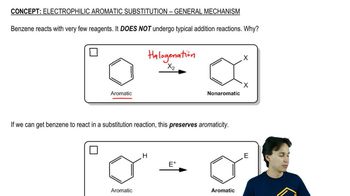
Electrophilic aromatic substitution (EAS) is a fundamental reaction in organic chemistry where an electrophile replaces a hydrogen atom on an aromatic ring. In the case of converting aniline to fluorobenzene and chlorobenzene, EAS is crucial as it allows the introduction of halogen substituents onto the benzene ring. The presence of the amino group (-NH2) in aniline activates the ring towards electrophilic attack, making it more reactive.
추천 영상:
03:07
EAS Review

Halogenation of Aromatic Compounds

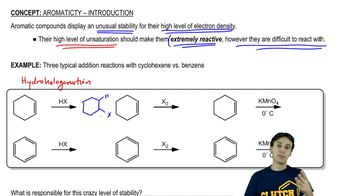
Halogenation involves the introduction of halogen atoms (like fluorine or chlorine) into an organic compound. For aniline, this process typically requires the use of a halogenating agent, such as bromine or chlorine, often in the presence of a catalyst like iron or aluminum chloride. The choice of halogenating agent and conditions can influence the selectivity and yield of the desired halogenated product.
추천 영상:
08:19
Intro to Aromaticity

Deactivation of the Amino Group

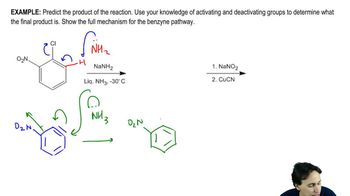
While the amino group in aniline is a strong activating group for electrophilic substitution, it can also lead to complications in halogenation reactions. The amino group can be deactivated under certain conditions, such as when converting aniline to chlorobenzene, where the amino group may need to be temporarily protected or converted to a less reactive form to prevent multiple substitutions or side reactions.
추천 영상:
03:27
Activating and deactivating groups