Ch. 19 - Amines
Wade - Organic Chemistry 9th Edition
Wade9th EditionOrganic ChemistryISBN: 9780135213728당신이 사용하는 게 아니라요?교과서 변경
19장, 문제 25f

Show how you would convert aniline to the following compounds.
(f) benzonitrile

검증된 단계별 안내
1
Step 1: Begin with aniline (C₆H₅NH₂) as the starting material. Aniline contains an amino group (-NH₂) attached to a benzene ring.
Step 2: Protect the amino group by converting it into a diazonium salt. This is achieved by reacting aniline with sodium nitrite (NaNO₂) and hydrochloric acid (HCl) at 0–5°C. The reaction forms benzene diazonium chloride (C₆H₅N₂⁺Cl⁻). The reaction can be represented as: C₆H₅NH₂ + NaNO₂ + 2HCl → C₆H₅N₂⁺Cl⁻ + 2H₂O.
Step 3: Perform a Sandmeyer reaction to replace the diazonium group (-N₂⁺) with a cyano group (-CN). This is done by treating the benzene diazonium chloride with copper(I) cyanide (CuCN) in the presence of potassium cyanide (KCN). The reaction produces benzonitrile (C₆H₅CN) as the product.
Step 4: Isolate and purify the benzonitrile product. This can be done using standard organic purification techniques such as distillation or recrystallization, depending on the physical properties of the product.
Step 5: Verify the structure of the product using spectroscopic techniques such as IR spectroscopy (look for the characteristic C≡N stretching vibration around 2200–2250 cm⁻¹) and NMR spectroscopy to confirm the successful conversion of aniline to benzonitrile.

비슷한 문제에 대한 검증된 영상 답변:

이 영상 해법은 위 문제에 도움이 된다고 튜터들이 추천한 것입니다.
영상 길이:
59s

주요 개념

질문에 올바르게 답하기 위해 반드시 이해해야 하는 핵심 개념들은 다음과 같습니다.

Aniline Structure and Reactivity

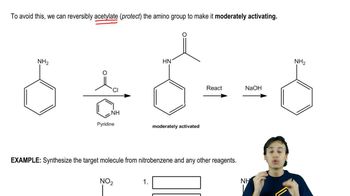
Aniline is an aromatic amine with the formula C6H5NH2. Its amino group (-NH2) is a strong activating group for electrophilic aromatic substitution reactions, making the benzene ring more reactive towards electrophiles. Understanding the structure and reactivity of aniline is crucial for determining the appropriate reaction pathways to convert it into other compounds.
추천 영상:
05:15
Protection of Aniline Derivatives

Nitration and Electrophilic Substitution

Nitration is a common electrophilic aromatic substitution reaction where a nitro group (-NO2) is introduced into an aromatic ring. This reaction typically involves the use of a nitrating mixture (concentrated HNO3 and H2SO4). In the context of converting aniline to benzonitrile, nitration can be a preliminary step to introduce a nitro group, which can then be further transformed into a nitrile group.
추천 영상:
01:47
Nucleophiles and Electrophiles can react in Substitution Reactions.

Conversion of Nitro Compounds to Nitriles

The conversion of nitro compounds to nitriles can be achieved through a reduction followed by dehydration. For example, nitroaniline can be reduced to an amine and then treated with a dehydrating agent, such as phosphorus oxychloride (POCl3), to form the corresponding nitrile. This transformation is essential for completing the conversion of aniline to benzonitrile.
추천 영상:
가이드 코스
0:42
Review of Nitriles Concept 5