Ch. 19 - Amines
Wade - Organic Chemistry 9th Edition
Wade9th EditionOrganic ChemistryISBN: 9780135213728당신이 사용하는 게 아니라요?교과서 변경
19장, 문제 45d

Synthesize from benzene. (Hint: All of these require diazonium ions.)
(d) 4-methoxyaniline

검증된 단계별 안내
1
Step 1: Start with benzene as the base compound. Perform a nitration reaction by treating benzene with a mixture of concentrated HNO₃ (nitric acid) and concentrated H₂SO₄ (sulfuric acid). This introduces a nitro group (-NO₂) onto the benzene ring, forming nitrobenzene.
Step 2: Reduce the nitro group (-NO₂) in nitrobenzene to an amino group (-NH₂) to form aniline. This can be achieved using a reducing agent such as Sn (tin) and HCl, or Fe (iron) and HCl, followed by neutralization with a base.
Step 3: Convert the amino group (-NH₂) in aniline to a diazonium ion (-N₂⁺) by performing a diazotization reaction. Treat aniline with NaNO₂ (sodium nitrite) and HCl at 0–5°C to form the diazonium salt (benzene diazonium chloride).
Step 4: Replace the diazonium group (-N₂⁺) with a methoxy group (-OCH₃) to form 4-methoxyaniline. This can be achieved through a Sandmeyer reaction using Cu₂O and methanol (CH₃OH) as the reagents. The methoxy group will be introduced at the para position relative to the amino group.
Step 5: Ensure the product is purified and characterized to confirm the synthesis of 4-methoxyaniline. Techniques such as recrystallization, melting point determination, and spectroscopic analysis (e.g., IR, NMR) can be used for verification.

비슷한 문제에 대한 검증된 영상 답변:

이 영상 해법은 위 문제에 도움이 된다고 튜터들이 추천한 것입니다.
영상 길이:
7m

주요 개념

질문에 올바르게 답하기 위해 반드시 이해해야 하는 핵심 개념들은 다음과 같습니다.

Benzene and its Derivatives

Benzene is a fundamental aromatic hydrocarbon characterized by its stable ring structure and delocalized π-electrons. Understanding benzene's reactivity is crucial, as it undergoes electrophilic substitution reactions rather than addition, allowing for the introduction of various functional groups while preserving its aromaticity.
추천 영상:
02:49
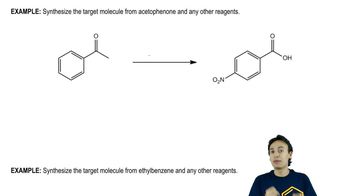
Aromatic synthesis starting with benzene/benzene derivatives

Diazonium Ions

Diazonium ions are highly reactive intermediates formed from primary aromatic amines and nitrous acid. They play a pivotal role in organic synthesis, particularly in the formation of azo compounds and in electrophilic aromatic substitution reactions, where they can introduce substituents onto aromatic rings.
추천 영상:
가이드 코스
3:39
Metal Ion Catalysis Concept 1

Electrophilic Aromatic Substitution

Electrophilic aromatic substitution (EAS) is a key reaction mechanism in organic chemistry where an electrophile replaces a hydrogen atom on an aromatic ring. This process is essential for synthesizing substituted aromatic compounds, such as 4-methoxyaniline, by utilizing diazonium ions to introduce new functional groups onto the benzene ring.
추천 영상:
03:07
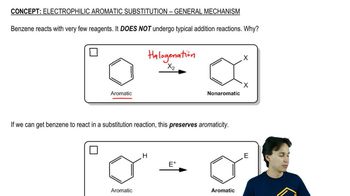
EAS Review