Ch. 19 - Amines
Wade - Organic Chemistry 9th Edition
Wade9th EditionOrganic ChemistryISBN: 9780135213728당신이 사용하는 게 아니라요?교과서 변경
19장, 문제 47d

The two most general amine syntheses are the reductive amination of carbonyl compounds and the reduction of amides. Show how these techniques can be used to accomplish the following syntheses.
(d) cyclohexanone → N-cyclohexylpyrrolidine

검증된 단계별 안내
1
Identify the starting material (cyclohexanone) and the target product (N-cyclohexylpyrrolidine). Recognize that the transformation involves introducing a pyrrolidine group to the cyclohexane ring via an amine synthesis method.
Choose reductive amination as the appropriate method for this synthesis. Reductive amination involves reacting a carbonyl compound (cyclohexanone) with an amine (pyrrolidine) in the presence of a reducing agent to form the desired amine product.
Write the reaction mechanism: In the first step, cyclohexanone reacts with pyrrolidine to form an imine intermediate. This occurs through nucleophilic attack of the amine nitrogen on the carbonyl carbon, followed by the elimination of water.
In the second step, the imine intermediate is reduced to the corresponding amine (N-cyclohexylpyrrolidine) using a reducing agent such as sodium cyanoborohydride (NaBH₃CN) or hydrogen gas with a metal catalyst (e.g., Pd/C).
Ensure proper reaction conditions: Use an appropriate solvent (e.g., ethanol or methanol) and maintain mild reaction conditions to facilitate the reductive amination process without side reactions. This will yield N-cyclohexylpyrrolidine as the final product.

비슷한 문제에 대한 검증된 영상 답변:

이 영상 해법은 위 문제에 도움이 된다고 튜터들이 추천한 것입니다.
영상 길이:
2m

주요 개념

질문에 올바르게 답하기 위해 반드시 이해해야 하는 핵심 개념들은 다음과 같습니다.

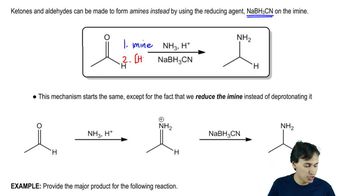
Reductive Amination

Reductive amination is a chemical reaction that involves the conversion of a carbonyl compound, such as an aldehyde or ketone, into an amine. This process typically involves the formation of an intermediate imine or enamine, which is then reduced to yield the amine. In the context of synthesizing N-cyclohexylpyrrolidine from cyclohexanone, this method allows for the introduction of the amine group through the reaction with an appropriate amine and subsequent reduction.
추천 영상:
07:12
Reductive Amination

Amide Reduction

The reduction of amides is a method used to convert amides into amines. This process often involves the use of reducing agents such as lithium aluminum hydride (LiAlH4) or borane (BH3), which effectively add hydrogen to the carbonyl carbon of the amide, resulting in the formation of an amine. Understanding this concept is crucial for exploring alternative pathways to synthesize amines, including N-cyclohexylpyrrolidine.
추천 영상:
01:33
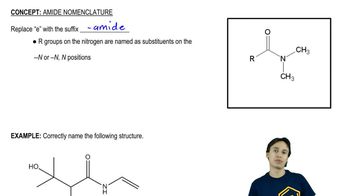
Amide Nomenclature

Pyrrolidine Structure and Synthesis

Pyrrolidine is a five-membered saturated heterocyclic amine with the formula C4H9N. Its synthesis often involves the formation of a cyclic structure through the reaction of a suitable precursor, such as an amine and a carbonyl compound. In the case of synthesizing N-cyclohexylpyrrolidine, recognizing the structural features of pyrrolidine and the necessary reaction conditions is essential for successfully completing the synthesis from cyclohexanone.
추천 영상:
가이드 코스
1:16
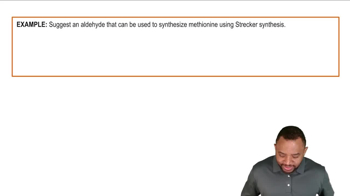
Synthesis of Amino Acids: Strecker Synthesis Example 1
관련 실천
교과서 질문

The two most general amine syntheses are the reductive amination of carbonyl compounds and the reduction of amides. Show how these techniques can be used to accomplish the following syntheses.

(b) benzaldehyde → benzylamine

1507
views

교과서 질문

Several additional amine syntheses are effectively limited to making primary amines. The reduction of azides and nitro compounds and the Gabriel synthesis leave the carbon chain unchanged. Formation and reduction of a nitrile adds one carbon atom. Show how these amine syntheses can be used for the following conversions.

(c) 1-bromo-3-phenylheptane → 3-phenylheptan-1-amine

852
views
교과서 질문

Several additional amine syntheses are effectively limited to making primary amines. The reduction of azides and nitro compounds and the Gabriel synthesis leave the carbon chain unchanged. Formation and reduction of a nitrile adds one carbon atom. Show how these amine syntheses can be used for the following conversions.

(a) allyl bromide → allylamine 

867
views
교과서 질문

The two most general amine syntheses are the reductive amination of carbonyl compounds and the reduction of amides. Show how these techniques can be used to accomplish the following syntheses.

(a) benzoic acid → benzylamine

1059
views
교과서 질문

Show how you can synthesize the following tertiary amine three different ways, each using a different secondary amine and adding the final substituent by

(a) reductive amination (3 ways).

622
views
교과서 질문

The two most general amine syntheses are the reductive amination of carbonyl compounds and the reduction of amides. Show how these techniques can be used to accomplish the following syntheses.

(c) pyrrolidine → N-ethylpyrrolidine

93
views