Ch. 19 - Amines
Wade - Organic Chemistry 9th Edition
Wade9th EditionOrganic ChemistryISBN: 9780135213728당신이 사용하는 게 아니라요?교과서 변경
19장, 문제 13

We have considered nucleophilic aromatic substitution of pyridine at the 2-position and 3-position but not at the 4-position. Complete the three possible cases by showing the mechanism for the reaction of methoxide ion with 4-chloropyridine. Show how the intermediate is stabilized by delocalization of the charge onto the nitrogen atom.

검증된 단계별 안내
1
Identify the type of reaction: This is a nucleophilic aromatic substitution (NAS) reaction, where the methoxide ion (CH₃O⁻) acts as the nucleophile, and 4-chloropyridine is the substrate. The chlorine atom is the leaving group.
Determine the site of attack: The methoxide ion will attack the carbon atom at the 4-position of the pyridine ring, where the chlorine atom is attached. This attack occurs because the electron-deficient aromatic ring is activated by the electronegative nitrogen atom in pyridine.
Illustrate the addition step: The methoxide ion attacks the 4-position carbon, forming a negatively charged intermediate. This intermediate is a Meisenheimer complex, where the negative charge is delocalized across the ring and onto the nitrogen atom. Use resonance structures to show how the charge is stabilized. For example, one resonance structure will have the negative charge on the nitrogen atom, while others will show the charge on different carbons in the ring.
Depict the elimination step: After the intermediate is stabilized, the chlorine atom leaves as a chloride ion (Cl⁻), restoring aromaticity to the pyridine ring. This step completes the substitution reaction.
Summarize the overall reaction: The final product is 4-methoxypyridine, where the methoxide group has replaced the chlorine atom at the 4-position. The reaction mechanism demonstrates how the intermediate is stabilized by delocalization of the negative charge onto the nitrogen atom through resonance.

비슷한 문제에 대한 검증된 영상 답변:

이 영상 해법은 위 문제에 도움이 된다고 튜터들이 추천한 것입니다.

주요 개념

질문에 올바르게 답하기 위해 반드시 이해해야 하는 핵심 개념들은 다음과 같습니다.

Nucleophilic Aromatic Substitution (NAS)

Nucleophilic aromatic substitution is a reaction where a nucleophile replaces a leaving group on an aromatic ring. This process typically occurs when the aromatic compound has electron-withdrawing groups that stabilize the negative charge in the intermediate. In the case of pyridine, the nitrogen atom can influence the reactivity and stability of the intermediate formed during the substitution.
추천 영상:
02:10
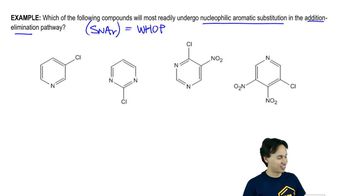
NAS in the addition-elimination pathway

Mechanism of NAS

The mechanism of nucleophilic aromatic substitution generally involves two key steps: the formation of a Meisenheimer complex (an intermediate) and the elimination of the leaving group. In the case of 4-chloropyridine, the methoxide ion attacks the carbon bearing the chlorine, forming a negatively charged intermediate that can be stabilized by resonance, particularly through delocalization of the charge onto the nitrogen atom.
추천 영상:
09:32
NAS - The Three Rules

Resonance Stabilization

Resonance stabilization refers to the delocalization of electrons across adjacent atoms, which can lower the energy of a molecule and increase its stability. In the context of the intermediate formed during the nucleophilic substitution of 4-chloropyridine, the negative charge can be delocalized onto the nitrogen atom of the pyridine ring, allowing for multiple resonance structures that distribute the charge and enhance the stability of the intermediate.
추천 영상:
03:43
The radical stability trend.