Ch. 20 - Carboxylic Acids
Wade - Organic Chemistry 9th Edition
Wade9th EditionOrganic ChemistryISBN: 9780135213728당신이 사용하는 게 아니라요?교과서 변경
20장, 문제 37d

Predict the products and propose mechanisms for the following reactions.
(d)

검증된 단계별 안내
1
Analyze the given reaction: Identify the type of reaction (e.g., substitution, elimination, addition, etc.) based on the reactants, reagents, and conditions provided. Look for functional groups and any specific reagents that indicate the reaction pathway.
Predict the products: Based on the reaction type, determine the possible products. For example, if the reaction involves a nucleophilic substitution, consider whether it follows an SN1 or SN2 mechanism. If it involves elimination, determine whether it is E1 or E2.
Propose the mechanism: Break down the reaction into individual steps. For example, if it is an SN1 reaction, describe the formation of the carbocation intermediate and the subsequent attack by the nucleophile. Use curved arrows to show the movement of electrons.
Consider stereochemistry: If the reaction involves chiral centers or stereochemical outcomes, analyze whether the product will be racemic, retain configuration, or invert configuration. This depends on the mechanism (e.g., SN2 leads to inversion of configuration).
Verify the reaction conditions: Ensure that the proposed mechanism and products are consistent with the reagents and conditions provided in the problem. For example, strong bases favor elimination (E2), while polar protic solvents favor SN1 reactions.

비슷한 문제에 대한 검증된 영상 답변:

이 영상 해법은 위 문제에 도움이 된다고 튜터들이 추천한 것입니다.
영상 길이:
1m

주요 개념

질문에 올바르게 답하기 위해 반드시 이해해야 하는 핵심 개념들은 다음과 같습니다.

Reaction Mechanisms

Reaction mechanisms describe the step-by-step process by which reactants transform into products. Understanding these mechanisms involves identifying the intermediates, transition states, and the sequence of bond-breaking and bond-forming events. This knowledge is crucial for predicting the products of a reaction and understanding the underlying chemistry.
추천 영상:
02:16
Heck Reaction Mechanism

Types of Organic Reactions

Organic reactions can be classified into several types, including substitution, addition, elimination, and rearrangement reactions. Each type has distinct characteristics and mechanisms. Recognizing the type of reaction occurring helps in predicting the products and understanding the conditions under which the reaction takes place.
추천 영상:
07:37
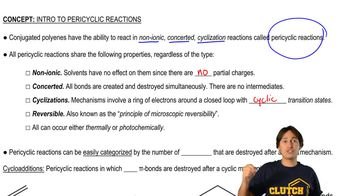
Properties and Types of Pericyclic Reactions

Functional Groups

Functional groups are specific groups of atoms within molecules that are responsible for the characteristic chemical reactions of those molecules. Identifying functional groups in reactants is essential for predicting the products of a reaction, as they dictate reactivity and the types of transformations that can occur during the reaction.
추천 영상:
02:36
Identifying Functional Groups