Ch. 20 - Carboxylic Acids
Wade - Organic Chemistry 9th Edition
Wade9th EditionOrganic ChemistryISBN: 9780135213728당신이 사용하는 게 아니라요?교과서 변경
20장, 문제 24a

Show how you would use an acid chloride as an intermediate to synthesize.
(a) N-phenylbenzamide (PhCONHPh) from benzoic acid and aniline.

검증된 단계별 안내
1
Convert benzoic acid (C₆H₅COOH) to benzoyl chloride (C₆H₅COCl) using thionyl chloride (SOCl₂) or oxalyl chloride ((COCl)₂). This reaction replaces the hydroxyl group (-OH) of the carboxylic acid with a chlorine atom, forming the acid chloride. The reaction is: C₆H₅COOH + SOCl₂ → C₆H₅COCl + SO₂ + HCl.
Prepare aniline (C₆H₅NH₂) as the nucleophile for the next step. Ensure that the aniline is in its free base form (not protonated) to act as a nucleophile effectively.
React benzoyl chloride (C₆H₅COCl) with aniline (C₆H₅NH₂) in the presence of a base, such as pyridine or triethylamine, to neutralize the HCl byproduct. This reaction is a nucleophilic acyl substitution, where the amine group (-NH₂) attacks the carbonyl carbon of the acid chloride, replacing the chlorine atom. The reaction is: C₆H₅COCl + C₆H₅NH₂ → C₆H₅CONHC₆H₅ + HCl.
The base (e.g., pyridine) reacts with the HCl byproduct to form a salt, preventing the reaction medium from becoming too acidic, which could deactivate the nucleophile.
Purify the product, N-phenylbenzamide (C₆H₅CONHC₆H₅), by recrystallization or another appropriate method to isolate the desired compound.

비슷한 문제에 대한 검증된 영상 답변:

이 영상 해법은 위 문제에 도움이 된다고 튜터들이 추천한 것입니다.
영상 길이:
2m

주요 개념

질문에 올바르게 답하기 위해 반드시 이해해야 하는 핵심 개념들은 다음과 같습니다.

Acid Chlorides

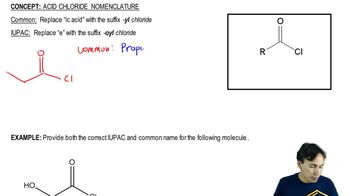
Acid chlorides, also known as acyl chlorides, are derivatives of carboxylic acids where the hydroxyl group is replaced by a chlorine atom. They are highly reactive and serve as excellent intermediates in organic synthesis, particularly for forming amides and esters. In this context, acid chlorides can react with amines to produce amides, making them crucial for the synthesis of compounds like N-phenylbenzamide.
추천 영상:
03:13
Acid Chloride Nomenclature

Nucleophilic Acyl Substitution

Nucleophilic acyl substitution is a fundamental reaction mechanism in organic chemistry where a nucleophile attacks the carbonyl carbon of an acyl compound, leading to the substitution of a leaving group. In the case of acid chlorides, the chlorine atom is the leaving group, and the nucleophile can be an amine, such as aniline. This reaction is key to converting acid chlorides into amides, such as N-phenylbenzamide.
추천 영상:
01:47
Nucleophiles and Electrophiles can react in Substitution Reactions.

Synthesis of Amides

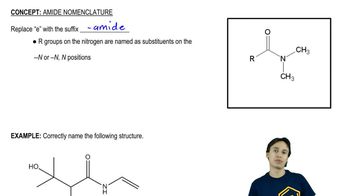
The synthesis of amides involves the reaction of carboxylic acid derivatives, like acid chlorides, with amines. This process typically results in the formation of an amide bond (C=O-N) and is characterized by the release of a small molecule, often HCl. Understanding this reaction is essential for synthesizing compounds like N-phenylbenzamide from benzoic acid and aniline, as it highlights the transformation of functional groups in organic synthesis.
추천 영상:
01:33
Amide Nomenclature