Ch. 21 - Carboxylic Acid Derivatives
Wade - Organic Chemistry 9th Edition
Wade9th EditionOrganic ChemistryISBN: 9780135213728당신이 사용하는 게 아니라요?교과서 변경
21장, 문제 42n,o

Draw structures to correspond with the following common and systematic names:
(n) trichloroacetic anhydride
(o) ethyl N-methyl carbamate

검증된 단계별 안내
1
Step 1: Understand the structure of trichloroacetic anhydride. An anhydride is formed by the condensation of two carboxylic acids. Trichloroacetic acid has the formula Cl₃C-COOH. To form the anhydride, two molecules of trichloroacetic acid lose a water molecule, resulting in the structure Cl₃C-CO-O-CO-CCl₃.
Step 2: Draw the structure of trichloroacetic anhydride. Start by drawing two trichloroacetic acid molecules (Cl₃C-COOH). Then, connect the carbonyl groups (C=O) of each molecule via an oxygen atom (O) to form the anhydride bond.
Step 3: Understand the structure of ethyl N-methyl carbamate. A carbamate is a functional group with the general structure R-O-C(=O)-NR₂. In this case, the R group attached to the oxygen is an ethyl group (CH₃CH₂-), and one of the substituents on the nitrogen is a methyl group (CH₃).
Step 4: Draw the structure of ethyl N-methyl carbamate. Start with the carbamate backbone (R-O-C(=O)-NR₂). Replace the R group attached to the oxygen with an ethyl group (CH₃CH₂-), and replace one of the R groups on the nitrogen with a methyl group (CH₃). The final structure is CH₃CH₂-O-C(=O)-NHCH₃.
Step 5: Verify the structures. Ensure that all atoms have the correct number of bonds and that the functional groups match the names provided. For trichloroacetic anhydride, confirm the presence of two trichloromethyl groups (Cl₃C-) and the anhydride bond. For ethyl N-methyl carbamate, confirm the ethyl group, carbamate group, and N-methyl substitution.

비슷한 문제에 대한 검증된 영상 답변:

이 영상 해법은 위 문제에 도움이 된다고 튜터들이 추천한 것입니다.
영상 길이:
1m

주요 개념

질문에 올바르게 답하기 위해 반드시 이해해야 하는 핵심 개념들은 다음과 같습니다.

Anhydrides

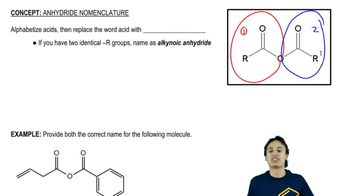
Anhydrides are compounds formed from the removal of water from an acid. In organic chemistry, they often result from the condensation of two carboxylic acids or a carboxylic acid and an alcohol. Trichloroacetic anhydride, for example, is derived from trichloroacetic acid and is used in various chemical reactions, including acylation.
추천 영상:
03:35
Anhydride Nomenclature

Carbamates

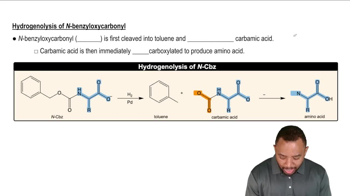
Carbamates are esters of carbamic acid, characterized by the presence of the -NH(C=O)O- functional group. They are commonly used in pharmaceuticals and pesticides. Ethyl N-methyl carbamate, specifically, is an example where an ethyl group is attached to the oxygen of the carbamate, influencing its chemical properties and reactivity.
추천 영상:
가이드 코스
1:38
Reactions of Amino Acids: Hydrogenolysis Concept 2

Nomenclature in Organic Chemistry

Nomenclature in organic chemistry refers to the systematic method of naming chemical compounds based on their structure and functional groups. The IUPAC (International Union of Pure and Applied Chemistry) system provides rules for naming compounds, ensuring that each name conveys specific information about the molecular structure, such as the presence of functional groups and the arrangement of atoms.
추천 영상:
00:56
What is an organic molecule?