Propose a mechanism for the reaction of benzyl alcohol with acetyl chloride to give benzyl acetate.
Ch. 21 - Carboxylic Acid Derivatives
21장, 문제 1m,n
Name the following carboxylic acid derivatives, giving both a common name and an IUPAC name where possible.
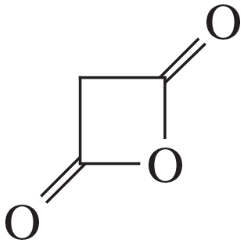
(m) 
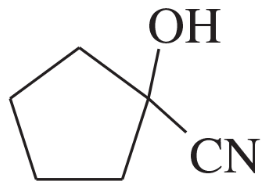
(n) 
검증된 단계별 안내1
Step 1: Analyze the first structure (m). The molecule contains a four-membered cyclic structure with two carbonyl groups attached. This is a cyclic anhydride derived from a dicarboxylic acid. To name it, identify the parent dicarboxylic acid and replace 'acid' with 'anhydride' for the common name. For the IUPAC name, use the systematic name of the parent dicarboxylic acid and add 'anhydride'.
Step 2: For the common name of structure (m), recognize that the parent dicarboxylic acid is succinic acid (butane-1,4-dioic acid). Replace 'acid' with 'anhydride' to get 'succinic anhydride'.
Step 3: For the IUPAC name of structure (m), use the systematic name of the parent dicarboxylic acid, which is butane-1,4-dioic acid. Replace 'acid' with 'anhydride' to get 'butane-1,4-dioic anhydride'.
Step 4: Analyze the second structure (n). The molecule contains a cyclopentane ring with two substituents: a hydroxyl group (-OH) and a nitrile group (-CN). Determine the priority of functional groups according to IUPAC rules. The nitrile group has higher priority than the hydroxyl group.
Step 5: For the IUPAC name of structure (n), assign the nitrile group as the main functional group and the hydroxyl group as a substituent. Number the cyclopentane ring to give the nitrile group the lowest possible number. The name will be '2-hydroxycyclopentanecarbonitrile'. For the common name, describe it as 'hydroxycyclopentanecarbonitrile'.

비슷한 문제에 대한 검증된 영상 답변:
이 영상 해법은 위 문제에 도움이 된다고 튜터들이 추천한 것입니다.
영상 길이:
9m주요 개념
질문에 올바르게 답하기 위해 반드시 이해해야 하는 핵심 개념들은 다음과 같습니다.
Carboxylic Acid Derivatives
Carboxylic acid derivatives are compounds that can be derived from carboxylic acids by replacing the hydroxyl group (-OH) with another functional group. Common derivatives include esters, amides, anhydrides, and acyl chlorides. Understanding these derivatives is crucial for naming and identifying their structures, as they exhibit distinct reactivity and properties based on their functional groups.
추천 영상:
Intro to Carboxylic Acid Derivatives
IUPAC Nomenclature
IUPAC nomenclature is a systematic method for naming chemical compounds, ensuring that each name conveys specific information about the structure and functional groups present. For carboxylic acid derivatives, the IUPAC name typically reflects the parent acid and the substituents or modifications made to it. Familiarity with IUPAC rules is essential for accurately naming compounds and communicating chemical information.
추천 영상:
The different parts of an IUPAC name
Functional Groups
Functional groups are specific groups of atoms within molecules that are responsible for the characteristic chemical reactions of those molecules. In the context of carboxylic acid derivatives, common functional groups include carbonyls (C=O), hydroxyls (–OH), and others that influence the compound's reactivity and properties. Recognizing these groups is vital for understanding the behavior and classification of organic compounds.
추천 영상:
Identifying Functional Groups
관련 실천
교과서 질문
2711
views
교과서 질문
Name the following carboxylic acid derivatives, giving both a common name and an IUPAC name where possible.
(d) PhNHCOCH2CH(CH3)2
(e) CH3CONHCH2Ph
1019
views
교과서 질문
Name the following carboxylic acid derivatives, giving both a common name and an IUPAC name where possible.
(a) PhCOOCH2CH(CH3)2
(b) PhOCHO
(c) PhCH(CH3)COOCH3
1575
views
교과서 질문
Name the following carboxylic acid derivatives, giving both a common name and an IUPAC name where possible.
(f) CH3CH(OH)CH2CN
1327
views
교과서 질문
Name the following carboxylic acid derivatives, giving both a common name and an IUPAC name where possible.
(o)
(p)
536
views
교과서 질문
Name the following carboxylic acid derivatives, giving both a common name and an IUPAC name where possible.
(q)
(r)
531
views