Ch. 21 - Carboxylic Acid Derivatives
Wade - Organic Chemistry 9th Edition
Wade9th EditionOrganic ChemistryISBN: 9780135213728당신이 사용하는 게 아니라요?교과서 변경
21장, 문제 34b

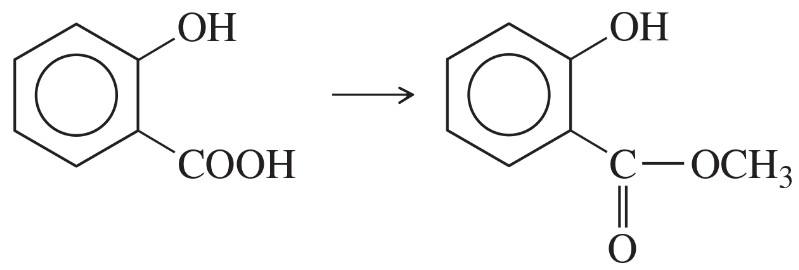
Suggest the most appropriate reagent for each synthesis, and explain your choice.
(b)

검증된 단계별 안내
1
Step 1: Analyze the transformation. The starting material is salicylic acid (a benzene ring with an -OH group and a -COOH group in ortho positions). The product is methyl salicylate, where the -COOH group has been converted into a methyl ester (-COOCH3). This indicates an esterification reaction.
Step 2: Identify the reagent required for esterification. Esterification typically involves reacting a carboxylic acid (-COOH) with an alcohol (e.g., methanol, CH3OH) in the presence of an acid catalyst, such as concentrated sulfuric acid (H2SO4). The acid catalyst helps protonate the carboxylic acid, making it more reactive.
Step 3: Write the general reaction mechanism. The carboxylic acid (-COOH) reacts with methanol (CH3OH) under acidic conditions. The hydroxyl group (-OH) of the carboxylic acid is replaced by the methoxy group (-OCH3) from methanol, forming the ester (-COOCH3). Water (H2O) is produced as a byproduct.
Step 4: Explain why methanol and sulfuric acid are appropriate choices. Methanol provides the methyl group (-CH3) needed for the ester, while sulfuric acid acts as a catalyst to speed up the reaction and ensure the formation of the ester. This combination is commonly used for esterification reactions.
Step 5: Summarize the synthesis. To convert salicylic acid into methyl salicylate, react salicylic acid with methanol in the presence of concentrated sulfuric acid. Heat the reaction mixture to facilitate the esterification process, and isolate the product after completion.

비슷한 문제에 대한 검증된 영상 답변:

이 영상 해법은 위 문제에 도움이 된다고 튜터들이 추천한 것입니다.
영상 길이:
3m

주요 개념

질문에 올바르게 답하기 위해 반드시 이해해야 하는 핵심 개념들은 다음과 같습니다.

Reagent Selection

Choosing the right reagent is crucial in organic synthesis as it determines the efficiency and outcome of the reaction. The selected reagent must be compatible with the starting materials and the desired product, taking into account factors such as reactivity, selectivity, and functional group compatibility.
추천 영상:
01:52
Reagents

Reaction Mechanisms

Understanding the underlying reaction mechanisms is essential for predicting how reagents will interact with substrates. This includes knowledge of nucleophiles, electrophiles, and the types of reactions (e.g., substitution, addition, elimination) that can occur, which helps in rationalizing the choice of reagents.
추천 영상:
02:16
Heck Reaction Mechanism

Functional Group Transformations

Functional groups dictate the chemical behavior of organic molecules. Recognizing the functional groups present in the reactants and the desired product allows chemists to select reagents that can effectively transform one functional group into another, facilitating the synthesis of complex molecules.
추천 영상:
02:36
Identifying Functional Groups