Ch. 23 - Carbohydrates and Nucleic Acids
Wade - Organic Chemistry 9th Edition
Wade9th EditionOrganic ChemistryISBN: 9780135213728당신이 사용하는 게 아니라요?교과서 변경
23장, 문제 43

Cytosine, uracil, and guanine have tautomeric forms with aromatic hydroxy groups. Draw these tautomeric forms.

검증된 단계별 안내
1
Understand the concept of tautomerism: Tautomerism is a type of isomerism where compounds exist in two interconvertible forms that differ in the position of a proton and the double bond. For cytosine, uracil, and guanine, the tautomeric forms involve keto-enol tautomerism, where a keto group (C=O) can convert to an enol group (-OH attached to a double-bonded carbon).
Identify the structure of cytosine: Cytosine is a pyrimidine base with an amino group (-NH2) at position 4 and a keto group (C=O) at position 2. The tautomeric form involves the migration of a proton from the amino group to the oxygen of the keto group, forming an enol group (-OH) at position 2.
Identify the structure of uracil: Uracil is a pyrimidine base with keto groups at positions 2 and 4. The tautomeric form involves the migration of a proton from one of the adjacent nitrogen atoms to the oxygen of a keto group, forming an enol group (-OH) at either position 2 or 4.
Identify the structure of guanine: Guanine is a purine base with a keto group at position 6 and an amino group at position 2. The tautomeric form involves the migration of a proton from the amino group to the oxygen of the keto group, forming an enol group (-OH) at position 6.
Draw the tautomeric forms: For each compound (cytosine, uracil, and guanine), redraw the structure to show the enol form. Ensure that the double bonds and proton positions are adjusted accordingly to reflect the tautomeric shift. Use proper resonance structures to depict aromaticity where applicable.

비슷한 문제에 대한 검증된 영상 답변:

이 영상 해법은 위 문제에 도움이 된다고 튜터들이 추천한 것입니다.

주요 개념

질문에 올바르게 답하기 위해 반드시 이해해야 하는 핵심 개념들은 다음과 같습니다.

Tautomerism

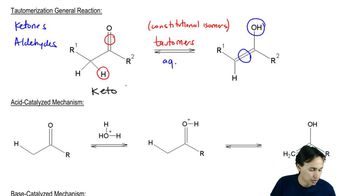
Tautomerism is a chemical phenomenon where compounds exist in two or more interconvertible forms, typically differing in the position of a proton and a double bond. This is particularly relevant in organic chemistry, as it can affect the reactivity and properties of molecules. In nucleobases like cytosine, uracil, and guanine, tautomeric forms can influence hydrogen bonding and base pairing in nucleic acids.
추천 영상:
05:11
Tautomerization Mechanisms

Aromatic Hydroxy Groups

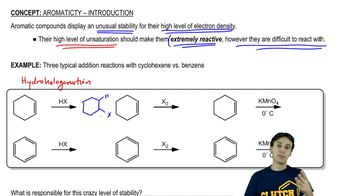
Aromatic hydroxy groups are functional groups that consist of a hydroxyl (-OH) group attached to an aromatic ring. These groups are significant in organic compounds because they can participate in hydrogen bonding and influence the stability and reactivity of the molecule. In the context of nucleobases, the presence of hydroxy groups can lead to different tautomeric forms that are crucial for their biological functions.
추천 영상:
08:19
Intro to Aromaticity

Nucleobase Structure

Nucleobases, such as cytosine, uracil, and guanine, are the building blocks of nucleic acids like DNA and RNA. Their structure includes a nitrogenous base, which can exist in various tautomeric forms, affecting their pairing and stability. Understanding the structural features of these bases, including the positions of functional groups, is essential for drawing their tautomeric forms and comprehending their roles in genetic information.
추천 영상:
03:04
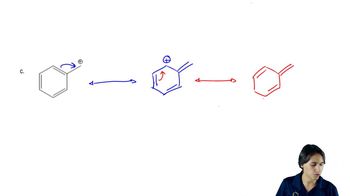
Drawing Resonance Structures
관련 실천
교과서 질문

Cellulose is converted to cellulose acetate by treatment with acetic anhydride and pyridine. Cellulose acetate is soluble in common organic solvents, and it is easily dissolved and spun into fibers. Show the structure of cellulose acetate.

149
views
교과서 질문

An aliphatic aminoglycoside is relatively stable to base, but it is quickly hydrolyzed by dilute acid. Propose a mechanism for the acid-catalyzed hydrolysis.

1365
views
교과서 질문

Ribonucleosides are not so easily hydrolyzed, requiring relatively strong acid. Using your mechanism for part (a), show why cytidine and adenosine (for example) are not so readily hydrolyzed. Explain why this stability is important for living organisms.

842
views
교과서 질문

Trehalose is a nonreducing disaccharide (C12H22O11) isolated from the poisonous mushroom Amanita muscaria. Treatment with an α-glucosidase converts trehalose to two molecules of glucose, but no reaction occurs when trehalose is treated with a β-glucosidase. When trehalose is methylated by dimethyl sulfate in mild base and then hydrolyzed, the only product is 2,3,4,6-tetra-O-methylglucose. Propose a complete structure and systematic name for trehalose.

670
views
교과서 질문

Raffinose is a trisaccharide (C18H32O16) isolated from cottonseed meal. Raffinose does not reduce Tollens reagent, and it does not mutarotate. Complete hydrolysis of raffinose gives D-glucose, D-fructose, and D-galactose. When raffinose is treated with invertase, the products are D-fructose and a reducing disaccharide called melibiose. Raffinose is unaffected by treatment with a β-galactosidase, but an α-galactosidase hydrolyzes it to D-galactose and sucrose. When raffinose is treated with dimethyl sulfate and base followed by hydrolysis, the products are 2,3,4-tri-O-methylglucose, 1,3,4,6-tetra-O-methylfructose, and 2,3,4,6-tetra-O-methylgalactose. Determine the complete structures of raffinose and melibiose, and give a systematic name for melibiose.

1467
views
교과서 질문

All of the rings of the four heterocyclic bases are aromatic. This is more apparent when the polar resonance forms of the amide groups are drawn, as is done for thymine here. Redraw the hydrogen-bonded guanine-cytosine and adenine-thymine pairs shown in Figure 23-24, using the polar resonance forms of the amides. Show how these forms help to explain why the hydrogen bonds involved in these pairings are particularly strong. Remember that a hydrogen bond arises between an electron-deficient hydrogen atom and an electron-rich pair of nonbonding electrons.

627
views