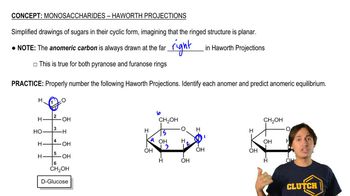
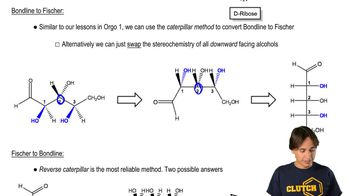
Figure 23-2 shows that the degradation of D-glucose gives D-arabinose, an aldopentose. Arabinose is most stable in its furanose form. Draw D-arabinofuranose.
Ch. 23 - Carbohydrates and Nucleic Acids
23장, 문제 7
Draw the Haworth projection for the cyclic structure of D-mannose by laying down the Fischer projection.
검증된 단계별 안내1
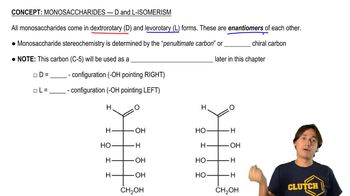
Start by identifying the Fischer projection of D-mannose. D-mannose is an aldohexose, meaning it has six carbons and an aldehyde group at the top. The hydroxyl (-OH) groups on the chiral carbons are arranged as follows: on the second carbon, the -OH is on the left; on the third carbon, the -OH is on the right; on the fourth carbon, the -OH is on the left; and on the fifth carbon, the -OH is on the right.
Determine the type of cyclic structure D-mannose forms. D-mannose typically forms a six-membered ring (pyranose) by reacting the aldehyde group on carbon 1 with the hydroxyl group on carbon 5, creating a hemiacetal linkage.
Convert the Fischer projection into a Haworth projection. To do this, orient the Fischer projection so that the groups on the right side of the Fischer projection point downward in the Haworth projection, and the groups on the left side point upward. For D-mannose, the -OH on carbon 2 points upward, the -OH on carbon 3 points downward, the -OH on carbon 4 points upward, and the -CH2OH group on carbon 5 points upward.
Add the anomeric carbon configuration. The anomeric carbon (carbon 1) can have two possible configurations: alpha (α) or beta (β). In the α-anomer, the -OH group on carbon 1 points downward, while in the β-anomer, the -OH group on carbon 1 points upward. Decide which anomer to draw based on the problem's requirements or draw both if unspecified.
Complete the Haworth projection by ensuring all atoms and bonds are correctly represented. Verify that the oxygen atom in the ring is between carbons 1 and 5, and that the substituents on each carbon are correctly positioned based on the rules for converting Fischer to Haworth projections.

비슷한 문제에 대한 검증된 영상 답변:
이 영상 해법은 위 문제에 도움이 된다고 튜터들이 추천한 것입니다.
주요 개념
질문에 올바르게 답하기 위해 반드시 이해해야 하는 핵심 개념들은 다음과 같습니다.
Haworth Projection
The Haworth projection is a way of representing the cyclic forms of sugars, showing the arrangement of atoms in a three-dimensional perspective. It illustrates the cyclic structure of monosaccharides, where the carbon atoms are represented in a ring format, and the hydroxyl groups and other substituents are positioned above or below the plane of the ring. This representation is crucial for understanding the stereochemistry and reactivity of carbohydrates.
추천 영상:
Monosaccharides - Haworth Projections
Fischer Projection
The Fischer projection is a two-dimensional representation of organic molecules, particularly sugars, that displays the configuration of chiral centers. In this format, the vertical lines represent bonds going back into the plane, while horizontal lines represent bonds coming out of the plane. Converting a Fischer projection to a Haworth projection involves identifying the orientation of substituents around the chiral centers to accurately depict the cyclic structure.
추천 영상:
Monosaccharides - Drawing Fischer Projections
D-Mannose
D-Mannose is a naturally occurring sugar and an epimer of glucose, differing at the C2 carbon. It is an aldohexose, meaning it contains six carbon atoms and an aldehyde functional group. Understanding the specific stereochemistry of D-mannose is essential for accurately drawing its cyclic form, as the orientation of hydroxyl groups in the Fischer projection directly influences the resulting Haworth projection.
추천 영상:
Monosaccharides - D and L Isomerism
관련 실천
교과서 질문
1034
views
교과서 질문
Which configuration (R or S) does the bottom asymmetric carbon have for the D series of sugars? Which configuration for the L series?
1090
views
교과서 질문
Talose is the C4 epimer of mannose. Draw the chair conformation of D-talopyranose.
1643
views
교과서 질문
Allose is the C3 epimer of glucose. Draw the cyclic hemiacetal form of D-allose, first in the chair conformation and then in the Haworth projection.
1669
views
교과서 질문
c. Draw d-idose, the C3 epimer of D-talose. Now compare your answers with Figure 23-3.
d. Draw the C4 “epimer” of D-xylose. Notice that this “epimer” is actually an L-series sugar, and we have seen its enantiomer. Give the correct name for this L-series sugar.
1234
views
교과서 질문
a. Draw D-allose, the C3 epimer of glucose.
b. Draw D-talose, the C2 epimer of d-galactose
2732
views
1
rank