
Ch. 23 - Carbohydrates and Nucleic Acids
Wade - Organic Chemistry 9th Edition
Wade9th EditionOrganic ChemistryISBN: 9780135213728당신이 사용하는 게 아니라요?교과서 변경
23장, 문제 19a

Except for the Tollens test, basic aqueous conditions are generally avoided with sugars because they lead to fast isomerizations.
(a) Under basic conditions, the proton alpha to the aldehyde (or ketone) carbonyl group is reversibly removed, and the resulting enolate ion is no longer asymmetric. Reprotonation can occur on either face of the enolate, giving either the original structure or its epimer. Because a mixture of epimers results, this process is called epimerization. Propose a mechanism for the base-catalyzed equilibration of glucose to a mixture of glucose and its C2 epimer, mannose.

검증된 단계별 안내
1
Step 1: Recognize the key concept of epimerization. Under basic conditions, the alpha proton (a hydrogen atom attached to the carbon adjacent to the carbonyl group) is acidic and can be removed by a base, forming an enolate ion. This enolate ion is planar and can be reprotonated on either face, leading to the formation of two different stereoisomers (epimers).
Step 2: Identify the starting molecule, glucose, and its C2 epimer, mannose. Glucose and mannose differ only in the stereochemistry at the C2 carbon. In glucose, the hydroxyl group at C2 is on the right (D-configuration), while in mannose, it is on the left.
Step 3: Write the mechanism for the base-catalyzed reaction. First, the base (e.g., OH⁻) abstracts the alpha proton from the carbon adjacent to the aldehyde group in glucose, forming an enolate ion. Represent this step using a curved arrow mechanism to show the movement of electrons.
Step 4: Show the planar enolate intermediate. The enolate ion is no longer asymmetric, as the sp² hybridized carbon is planar. This allows for reprotonation to occur on either face of the enolate, leading to two possible products: the original glucose or its epimer, mannose.
Step 5: Illustrate the reprotonation step. Use curved arrows to show the addition of a proton (H⁺) to the enolate ion. Reprotonation on one face regenerates glucose, while reprotonation on the opposite face forms mannose. This results in an equilibrium mixture of glucose and mannose under basic conditions.

비슷한 문제에 대한 검증된 영상 답변:

이 영상 해법은 위 문제에 도움이 된다고 튜터들이 추천한 것입니다.
도움이 되었나요?

주요 개념

질문에 올바르게 답하기 위해 반드시 이해해야 하는 핵심 개념들은 다음과 같습니다.

Enolate Ion Formation

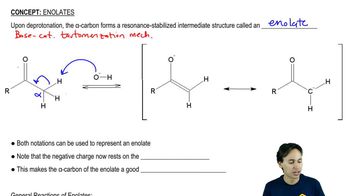
Enolate ions are formed when a proton is removed from the alpha carbon of a carbonyl compound, creating a resonance-stabilized anion. This process is crucial in organic reactions, particularly in aldol reactions and isomerizations, as it allows for the formation of new bonds. The enolate can react with electrophiles or undergo reprotonation, leading to different structural outcomes.
추천 영상:
02:26
Formation of Enolates

Epimerization

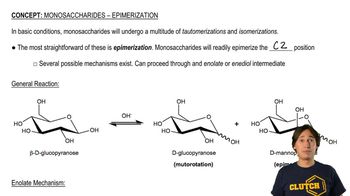
Epimerization is the process by which one epimer is converted into another through the reversible interconversion of stereocenters. In the context of sugars, this occurs when the configuration at a specific carbon atom (such as C2 in glucose) is altered, resulting in a mixture of epimers. This reaction is significant in carbohydrate chemistry as it affects the properties and reactivity of sugars.
추천 영상:
02:57
General Reaction

Base-Catalyzed Equilibration

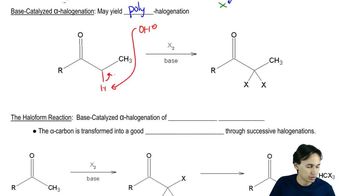
Base-catalyzed equilibration refers to the process where a base facilitates the conversion of one isomer to another, often through the formation of an enolate intermediate. In the case of sugars, this mechanism allows for the interconversion between different anomeric forms or epimers under basic conditions. Understanding this concept is essential for predicting the outcomes of reactions involving carbohydrates.
추천 영상:
01:57
Base Catalyzed