Ch. 23 - Carbohydrates and Nucleic Acids
Wade - Organic Chemistry 9th Edition
Wade9th EditionOrganic ChemistryISBN: 9780135213728당신이 사용하는 게 아니라요?교과서 변경
23장, 문제 52b

Predict the products obtained when d-galactose reacts with each reagent.
(b) NaOH, H2O

검증된 단계별 안내
1
Identify the structure of D-galactose: D-galactose is an aldohexose, meaning it contains six carbon atoms and an aldehyde functional group at the first carbon. It also has hydroxyl (-OH) groups attached to the other carbons in a specific stereochemical arrangement.
Understand the reaction conditions: The reagents NaOH and H2O indicate a basic aqueous environment. In such conditions, aldoses like D-galactose can undergo enediol rearrangement, which involves the formation of an enediol intermediate.
Describe the enediol rearrangement: The aldehyde group at C1 of D-galactose reacts with the hydroxide ion (OH⁻) to form an enolate ion. This enolate ion tautomerizes to form an enediol intermediate, which has hydroxyl groups on both C1 and C2.
Explain the possible outcomes: The enediol intermediate can rearrange back to the original aldehyde form (D-galactose) or isomerize to form other sugars. Specifically, D-galactose can isomerize to D-mannose or D-glucose, as these are epimers of D-galactose at different carbon centers (C2 and C4, respectively).
Summarize the products: The reaction in basic aqueous conditions will yield a mixture of D-galactose, D-glucose, and D-mannose due to the enediol rearrangement and isomerization processes.

비슷한 문제에 대한 검증된 영상 답변:

이 영상 해법은 위 문제에 도움이 된다고 튜터들이 추천한 것입니다.

주요 개념

질문에 올바르게 답하기 위해 반드시 이해해야 하는 핵심 개념들은 다음과 같습니다.

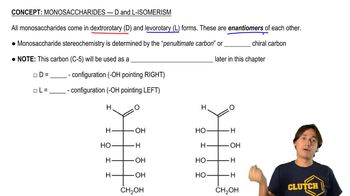
D-Galactose Structure

D-galactose is a six-carbon aldose sugar with a specific stereochemistry. It contains an aldehyde functional group and multiple hydroxyl groups, which influence its reactivity. Understanding its structure is crucial for predicting how it will interact with reagents like NaOH.
추천 영상:
06:47
Monosaccharides - D and L Isomerism

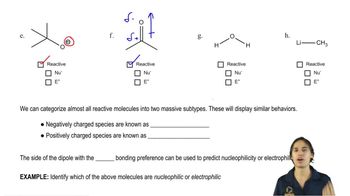
Aldose Reactivity

Aldoses, such as d-galactose, can undergo various reactions, including oxidation, reduction, and glycosidic bond formation. In the presence of a strong base like NaOH, aldoses can undergo isomerization or aldol reactions, which are essential to consider when predicting reaction products.
추천 영상:
01:17
Reactivity of Molecules

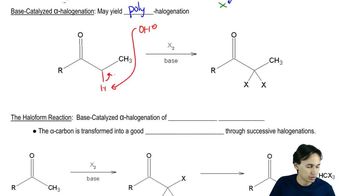
Base-Catalyzed Reactions

In organic chemistry, strong bases like NaOH can facilitate reactions by deprotonating functional groups or promoting nucleophilic attacks. In the case of d-galactose, NaOH can lead to the formation of an enolate ion, which can then react with water or other substrates, affecting the final products of the reaction.
추천 영상:
01:57
Base Catalyzed