
Ch. 23 - Carbohydrates and Nucleic Acids
Wade - Organic Chemistry 9th Edition
Wade9th EditionOrganic ChemistryISBN: 9780135213728당신이 사용하는 게 아니라요?교과서 변경
23장, 문제 14

When D-glucose is reduced with sodium borohydride, optically active glucitol results. When optically active D-galactose is reduced, however, the product is optically inactive. Explain this loss of optical activity.

검증된 단계별 안내
1
Understand the reaction: Sodium borohydride (NaBH₄) is a reducing agent that reduces the aldehyde group (-CHO) in aldoses like D-glucose and D-galactose to a primary alcohol (-CH₂OH), forming sugar alcohols (alditols).
Analyze the structure of D-glucose: D-glucose is reduced to D-glucitol (also known as sorbitol), which retains optical activity because it has multiple chiral centers and no internal symmetry.
Analyze the structure of D-galactose: D-galactose is reduced to galactitol. However, galactitol is a meso compound, meaning it has an internal plane of symmetry and is optically inactive despite having chiral centers.
Explain the loss of optical activity: The reduction of D-galactose results in a product (galactitol) that is a meso compound. Meso compounds are optically inactive because their mirror images are superimposable due to the internal plane of symmetry.
Conclude the reasoning: The difference in optical activity between the products of D-glucose and D-galactose reduction arises from the structural differences in their sugar alcohols. D-glucitol lacks an internal plane of symmetry, while galactitol possesses one, leading to optical inactivity in the latter.

비슷한 문제에 대한 검증된 영상 답변:

이 영상 해법은 위 문제에 도움이 된다고 튜터들이 추천한 것입니다.
영상 길이:
2m
도움이 되었나요?

주요 개념

질문에 올바르게 답하기 위해 반드시 이해해야 하는 핵심 개념들은 다음과 같습니다.

Optical Activity

Optical activity refers to the ability of a compound to rotate the plane of polarized light. This property is characteristic of chiral molecules, which have non-superimposable mirror images. The degree and direction of rotation depend on the specific arrangement of atoms in the molecule, making it crucial for distinguishing between different stereoisomers.
추천 영상:
08:17
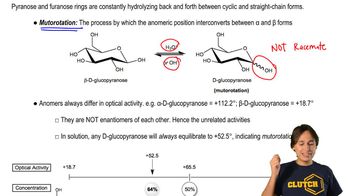
Mutorotation and Optical Activity

Chirality and Stereoisomers

Chirality is a property of a molecule that has at least one chiral center, typically a carbon atom bonded to four different substituents. Stereoisomers are compounds that have the same molecular formula and connectivity but differ in the spatial arrangement of their atoms. The presence of chirality in a molecule leads to the existence of enantiomers, which are mirror images of each other and can exhibit different optical activities.
추천 영상:
05:10
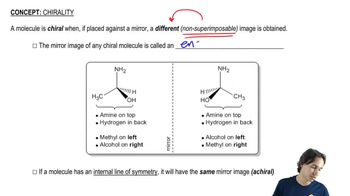
What is chirality?

Reduction Reactions

Reduction reactions involve the gain of electrons or hydrogen by a molecule, often resulting in the conversion of carbonyl groups (like aldehydes or ketones) to alcohols. In the case of D-glucose and D-galactose, the reduction with sodium borohydride alters their structures. The specific stereochemistry of the resulting alcohol can influence whether the product retains optical activity, as seen with glucitol being optically active and the product from D-galactose being optically inactive.
추천 영상:
07:12
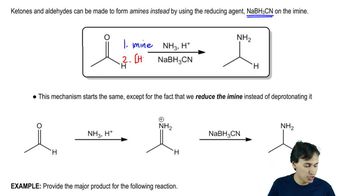
Reductive Amination