Ch. 24 - Amino Acids, Peptides, and Proteins
Wade - Organic Chemistry 9th Edition
Wade9th EditionOrganic ChemistryISBN: 9780135213728당신이 사용하는 게 아니라요?교과서 변경
24장, 문제 33

Show how you would use the Strecker synthesis to make tryptophan. What stereochemistry would you expect in your synthetic product?

검증된 단계별 안내
1
The Strecker synthesis is a method for synthesizing α-amino acids by reacting an aldehyde or ketone with ammonium chloride (NH₄Cl) and potassium cyanide (KCN), followed by hydrolysis. To synthesize tryptophan, start by identifying the appropriate aldehyde precursor. For tryptophan, the precursor is indole-3-acetaldehyde, which contains the indole ring structure characteristic of tryptophan.
React indole-3-acetaldehyde with ammonium chloride (NH₄Cl) and potassium cyanide (KCN). This step forms an α-aminonitrile intermediate. The reaction mechanism involves the formation of an imine (Schiff base) between the aldehyde group and ammonia, followed by nucleophilic addition of the cyanide ion (CN⁻) to the imine carbon.
Hydrolyze the α-aminonitrile intermediate under acidic or basic conditions to convert the nitrile group (-C≡N) into a carboxylic acid (-COOH). This step yields the α-amino acid structure of tryptophan.
Consider the stereochemistry of the product. The Strecker synthesis typically produces a racemic mixture of both L- and D-enantiomers of the amino acid because the reaction does not control the stereochemistry at the α-carbon. Tryptophan synthesized via this method will therefore be a 50:50 mixture of L-tryptophan and D-tryptophan.
To obtain a specific enantiomer, such as L-tryptophan (the biologically active form), additional steps like chiral resolution or the use of a chiral catalyst during synthesis would be required. These methods can separate or selectively produce one enantiomer from the racemic mixture.

비슷한 문제에 대한 검증된 영상 답변:

이 영상 해법은 위 문제에 도움이 된다고 튜터들이 추천한 것입니다.
영상 길이:
2m

주요 개념

질문에 올바르게 답하기 위해 반드시 이해해야 하는 핵심 개념들은 다음과 같습니다.

Strecker Synthesis

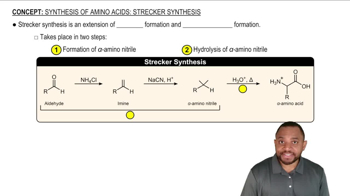
Strecker synthesis is a method for synthesizing amino acids through the reaction of an aldehyde with ammonia and hydrogen cyanide. This process involves the formation of an α-amino nitrile intermediate, which can be hydrolyzed to yield the corresponding amino acid. Understanding this reaction is crucial for synthesizing tryptophan, as it provides the foundational steps to construct the amino acid's structure.
추천 영상:
가이드 코스
1:39
Synthesis of Amino Acids: Strecker Synthesis Concept 1

Tryptophan Structure

Tryptophan is an essential amino acid characterized by its indole side chain, which contributes to its unique properties and biological functions. The structure includes an α-amino group, a carboxylic acid group, and the indole ring, making it a complex molecule. Recognizing the specific functional groups and their arrangement is vital for predicting the outcomes of the synthesis and the stereochemistry of the product.
추천 영상:
03:04
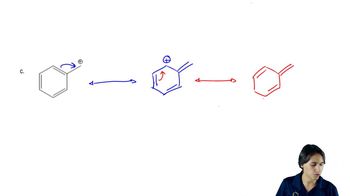
Drawing Resonance Structures

Stereochemistry

Stereochemistry refers to the study of the spatial arrangement of atoms in molecules and how this affects their chemical behavior. In the context of amino acids, chirality is significant, as they typically exist in L- and D- forms. For tryptophan, the expected product from Strecker synthesis would be the L-form, which is biologically active, highlighting the importance of stereochemical considerations in organic synthesis.
추천 영상:
가이드 코스
1:38
Polymer Stereochemistry Concept 1
관련 실천
교과서 질문

Show how you would convert alanine to the following derivatives. Show the structure of the product in each case.

(c) N-benzyloxycarbonyl alanine

(d) tert-butyloxycarbonyl alanine

836
views

교과서 질문

Suggest a method for the synthesis of the unnatural D enantiomer of alanine from the readily available L enantiomer of lactic acid.

1036
views
교과서 질문

Lipoic acid is often found near the active sites of enzymes, usually bound to the peptide by a long, flexible amide linkage with a lysine residue.


(a) Is lipoic acid a mild oxidizing agent or a mild reducing agent? Draw it in both its oxidized and reduced forms.

(b) Show how lipoic acid might react with two Cys residues to form a disulfide bridge.

(c) Give a balanced equation for the hypothetical oxidation or reduction, as you predicted in part (a), of an aldehyde by lipoic acid.

1358
views
교과서 질문

Aspartame (Nutrasweet®) is a remarkably sweet-tasting dipeptide ester. Complete hydrolysis of aspartame gives phenyl alanine, aspartic acid, and methanol. Mild incubation with carboxypeptidase has no effect on aspartame. Treatment of aspartame with phenyl isothiocyanate, followed by mild hydrolysis, gives the phenylthiohydantoin of aspartic acid. Propose a structure for aspartame.

1420
views
교과서 질문

Show how you would convert alanine to the following derivatives. Show the structure of the product in each case.

(a) alanine isopropyl ester

(b) N-benzoylalanine

1122
views
교과서 질문

Histidine is an important catalytic residue found at the active sites of many enzymes. In many cases, histidine appears to remove protons or to transfer protons from one location to another.

(a) Show which nitrogen atom of the histidine heterocycle is basic and which is not.

(b) Use resonance forms to show why the protonated form of histidine is a particularly stable cation.

(c) Show the structure that results when histidine accepts a proton on the basic nitrogen of the heterocycle and then is deprotonated on the other heterocyclic nitrogen. Explain how histidine might function as a pipeline to transfer protons between sites within an enzyme and its substrate.

1306
views