Ch.3 - Structure and Stereochemistry of Alkanes
Wade - Organic Chemistry 9th Edition
Wade9th EditionOrganic ChemistryISBN: 9780135213728당신이 사용하는 게 아니라요?교과서 변경
3장, 문제 9

Without looking at the structures, give molecular formulas for the compounds: (a) 4-(1,1-dimethylethyl)octane and (b) 5-(1,2,2-trimethylpropyl)nonane. Use the names of the groups to determine the number of carbon atoms; then use the (2n + 2) rule.

검증된 단계별 안내
1
Step 1: Begin by identifying the main chain in each compound. For compound (a), the main chain is octane, which has 8 carbon atoms. For compound (b), the main chain is nonane, which has 9 carbon atoms.
Step 2: Identify the substituents attached to the main chain. In compound (a), the substituent is 4-(1,1-dimethylethyl), which consists of a tert-butyl group. This group has 4 carbon atoms. In compound (b), the substituent is 5-(1,2,2-trimethylpropyl), which consists of a group with 6 carbon atoms.
Step 3: Add the number of carbon atoms from the main chain and the substituents. For compound (a), add 8 (from octane) and 4 (from the tert-butyl group) to get the total number of carbon atoms. For compound (b), add 9 (from nonane) and 6 (from the trimethylpropyl group) to get the total number of carbon atoms.
Step 4: Use the general formula for alkanes, CnH2n+2, to determine the number of hydrogen atoms. For compound (a), substitute the total number of carbon atoms into the formula to find the number of hydrogen atoms. Repeat the process for compound (b).
Step 5: Combine the number of carbon and hydrogen atoms to write the molecular formula for each compound. Ensure that the formula reflects the total number of each type of atom present in the compound.

비슷한 문제에 대한 검증된 영상 답변:

이 영상 해법은 위 문제에 도움이 된다고 튜터들이 추천한 것입니다.
영상 길이:
5m
도움이 되었나요?

주요 개념

질문에 올바르게 답하기 위해 반드시 이해해야 하는 핵심 개념들은 다음과 같습니다.

IUPAC Nomenclature

IUPAC nomenclature is a systematic method of naming organic chemical compounds as recommended by the International Union of Pure and Applied Chemistry (IUPAC). It provides a standardized way to describe the structure of a compound using specific rules, which include identifying the longest carbon chain, numbering the chain, and naming substituents.
추천 영상:
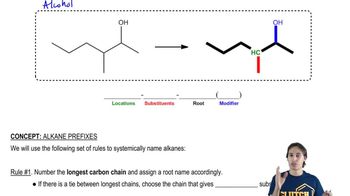
03:43
The different parts of an IUPAC name

Alkyl Groups

Alkyl groups are groups of carbon and hydrogen atoms arranged in a chain, derived from alkanes by removing one hydrogen atom. They are named based on the number of carbon atoms they contain, such as methyl (CH3), ethyl (C2H5), and propyl (C3H7). Understanding alkyl groups is crucial for determining the structure and molecular formula of complex organic compounds.
추천 영상:
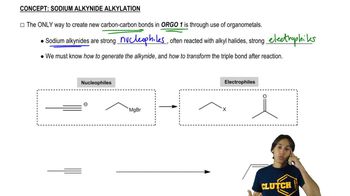
03:19
Sodium Alkynide Alkylation

Molecular Formula Calculation

The molecular formula of an alkane can be determined using the general formula CnH2n+2, where n is the number of carbon atoms. This formula accounts for the saturated nature of alkanes, which have single bonds between carbon atoms. By identifying the number of carbon atoms in the main chain and substituents, one can calculate the total number of hydrogen atoms to derive the molecular formula.
추천 영상:
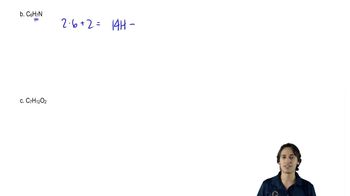
00:46
Calculating IHD using molecular formula