
Ch.3 - Structure and Stereochemistry of Alkanes
Wade - Organic Chemistry 9th Edition
Wade9th EditionOrganic ChemistryISBN: 9780135213728당신이 사용하는 게 아니라요?교과서 변경
3장, 문제 40e

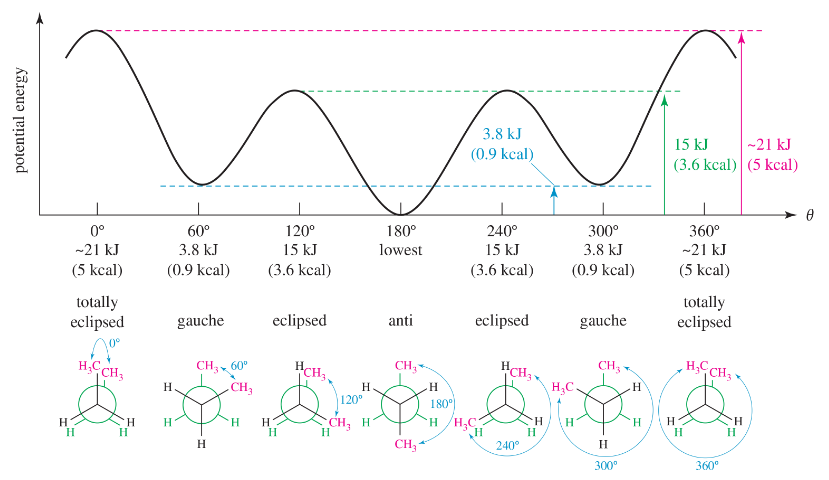
Construct a graph, similar to Figure 3-11, of the torsional energy of 3-methylpentane along the C2―C3 bond.
e. Indicate which conformations are the most stable (lowest energy) and the least stable (highest energy).

검증된 단계별 안내
1
Understand the concept of conformations: Conformations are different spatial arrangements of a molecule that result from rotation around single bonds. The stability of a conformation depends on factors such as steric hindrance, torsional strain, and angle strain.
Identify the molecule in question: To determine the most and least stable conformations, you need to know the specific molecule and its substituents. For example, in alkanes like butane, the conformations include anti, gauche, eclipsed, and fully eclipsed.
Analyze steric and torsional strain: The most stable conformation typically minimizes steric hindrance (repulsion between bulky groups) and torsional strain (repulsion between electron clouds in bonds). For example, in butane, the anti conformation (where bulky groups are 180° apart) is the most stable, while the fully eclipsed conformation (where bulky groups are directly aligned) is the least stable.
Use Newman projections to visualize conformations: Draw Newman projections to represent the molecule as viewed along the axis of a single bond. This helps in identifying the relative positions of substituents and assessing their interactions.
Rank the conformations: Based on the analysis of steric and torsional strain, rank the conformations from most stable (lowest energy) to least stable (highest energy). For example, in butane, the order is anti (most stable), gauche, eclipsed, and fully eclipsed (least stable).

비슷한 문제에 대한 검증된 영상 답변:

이 영상 해법은 위 문제에 도움이 된다고 튜터들이 추천한 것입니다.
영상 길이:
4m

주요 개념

질문에 올바르게 답하기 위해 반드시 이해해야 하는 핵심 개념들은 다음과 같습니다.

Conformational Analysis

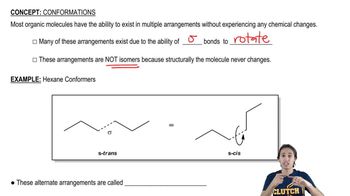
Conformational analysis involves studying the different spatial arrangements of a molecule that can be interconverted by rotation around single bonds. These arrangements, or conformers, can have varying degrees of stability based on steric interactions and torsional strain. Understanding this concept is crucial for determining which conformations of a molecule are more stable or less stable.
추천 영상:
03:29
Understanding what a conformer is.

Stability Factors

The stability of conformations is influenced by several factors, including steric hindrance, torsional strain, and angle strain. Steric hindrance occurs when atoms are forced too close together, leading to repulsion, while torsional strain arises from eclipsed interactions between atoms. Recognizing how these factors affect energy levels helps in identifying the most and least stable conformations.
추천 영상:
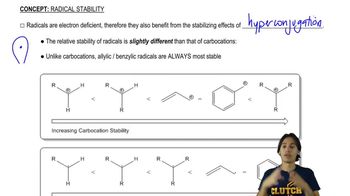
03:43
The radical stability trend.

Energy Diagrams

Energy diagrams visually represent the relative energies of different conformations of a molecule. These diagrams typically show energy on the vertical axis and the dihedral angle or rotation on the horizontal axis. By analyzing these diagrams, one can easily identify which conformations correspond to local minima (most stable) and maxima (least stable) in energy.
추천 영상:
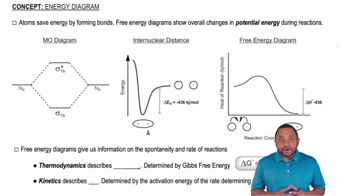
08:30
Introduction to free energy diagrams.