Ch.3 - Structure and Stereochemistry of Alkanes
Wade - Organic Chemistry 9th Edition
Wade9th EditionOrganic ChemistryISBN: 9780135213728당신이 사용하는 게 아니라요?교과서 변경
3장, 문제 48g,h

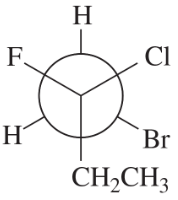
Convert each Newman projection to the equivalent line–angle formula, and assign the IUPAC name. g.
(g)
(h)

검증된 단계별 안내
1
Step 1: Analyze the Newman projection for structure (g). The front carbon (closest to the viewer) has three substituents: two hydrogens and one fluorine. The back carbon (farthest from the viewer) has three substituents: three fluorine atoms and a CBr3 group.
Step 2: Convert the Newman projection of structure (g) into a line-angle formula. The front carbon is bonded to two hydrogens and one fluorine, while the back carbon is bonded to three fluorine atoms and a CBr3 group. Arrange these substituents in a tetrahedral geometry around each carbon.
Step 3: Assign the IUPAC name for structure (g). Identify the longest carbon chain and prioritize substituents based on IUPAC rules. The CBr3 group is a trihalogenated substituent, and fluorine atoms are halogen substituents.
Step 4: Analyze the Newman projection for structure (h). The front carbon has three substituents: two hydrogens and one fluorine. The back carbon has three substituents: one ethyl group (CH2CH3), one bromine atom, and one chlorine atom.
Step 5: Convert the Newman projection of structure (h) into a line-angle formula. The front carbon is bonded to two hydrogens and one fluorine, while the back carbon is bonded to an ethyl group, a bromine atom, and a chlorine atom. Assign the IUPAC name by identifying the longest chain and prioritizing substituents based on IUPAC rules.

비슷한 문제에 대한 검증된 영상 답변:

이 영상 해법은 위 문제에 도움이 된다고 튜터들이 추천한 것입니다.
영상 길이:
4m

주요 개념

질문에 올바르게 답하기 위해 반드시 이해해야 하는 핵심 개념들은 다음과 같습니다.

Newman Projections

Newman projections are a way to visualize the conformation of a molecule by looking straight down the bond connecting two carbon atoms. This representation helps in understanding the spatial arrangement of substituents around the bond, which is crucial for analyzing steric interactions and torsional strain in organic compounds.
추천 영상:
00:34
Introduction to Drawing Newman Projections

Line-Angle Formulas

Line-angle formulas, also known as skeletal structures, are a simplified way to represent organic molecules. In this format, vertices represent carbon atoms, and lines represent bonds, with hydrogen atoms typically omitted for clarity. This method allows for quick visualization of molecular structure and connectivity, making it easier to identify functional groups and overall molecular geometry.
추천 영상:
02:46
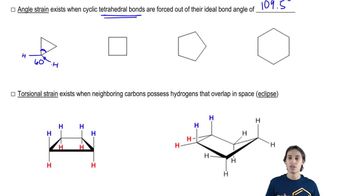
What is angle strain?

IUPAC Nomenclature

IUPAC nomenclature is a systematic method for naming organic chemical compounds. It provides rules for naming based on the structure of the molecule, including the longest carbon chain, functional groups, and substituents. Understanding these rules is essential for accurately identifying and communicating the identity of organic compounds, especially when converting between different structural representations.
추천 영상:
03:43
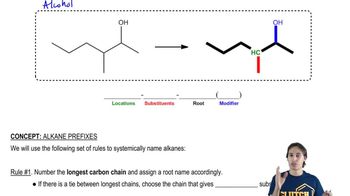
The different parts of an IUPAC name