Ch.3 - Structure and Stereochemistry of Alkanes
Wade - Organic Chemistry 9th Edition
Wade9th EditionOrganic ChemistryISBN: 9780135213728당신이 사용하는 게 아니라요?교과서 변경
3장, 문제 42a

In each pair of compounds, which compound has the higher boiling point? Explain your reasoning.
a. octane or 2,2,3-trimethylpentane

검증된 단계별 안내
1
Identify the structural differences between octane and 2,2,3-trimethylpentane. Octane is a straight-chain alkane with the formula C₈H₁₈, while 2,2,3-trimethylpentane is a branched alkane with the formula C₈H₁₈.
Understand the impact of molecular structure on boiling points. Straight-chain alkanes generally have higher boiling points than their branched counterparts due to increased surface area, which enhances van der Waals forces.
Consider the van der Waals forces. These are intermolecular forces that depend on the surface area of the molecule. A larger surface area in straight-chain alkanes allows for stronger van der Waals forces, leading to higher boiling points.
Analyze the branching in 2,2,3-trimethylpentane. The presence of branches reduces the surface area available for intermolecular interactions, thus decreasing the boiling point compared to a straight-chain alkane of the same molecular weight.
Conclude that octane, being a straight-chain alkane, will have a higher boiling point than 2,2,3-trimethylpentane due to stronger van der Waals forces resulting from its larger surface area.

비슷한 문제에 대한 검증된 영상 답변:

이 영상 해법은 위 문제에 도움이 된다고 튜터들이 추천한 것입니다.
영상 길이:
4m
도움이 되었나요?

주요 개념

질문에 올바르게 답하기 위해 반드시 이해해야 하는 핵심 개념들은 다음과 같습니다.

Boiling Point

The boiling point of a compound is the temperature at which its vapor pressure equals the atmospheric pressure, causing it to transition from liquid to gas. It is influenced by molecular weight, intermolecular forces, and molecular structure. Stronger intermolecular forces, such as hydrogen bonding or van der Waals forces, typically result in higher boiling points.
추천 영상:
03:08
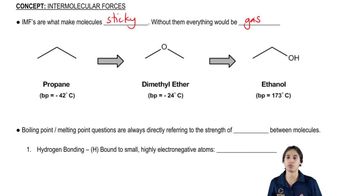
How IMFs are related to melting and boiling points.

Intermolecular Forces

Intermolecular forces are the forces that hold molecules together, affecting properties like boiling point and solubility. In hydrocarbons, van der Waals forces (dispersion forces) are predominant. Linear molecules, like octane, have stronger dispersion forces due to greater surface area contact compared to branched molecules, leading to higher boiling points.
추천 영상:
03:01
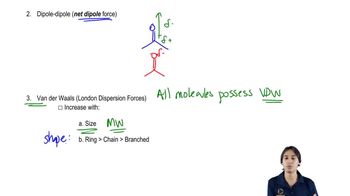
How Van der Waals forces work.

Molecular Structure

Molecular structure refers to the arrangement of atoms within a molecule, impacting its physical properties. Linear structures, such as octane, allow for more efficient packing and stronger intermolecular interactions than branched structures like 2,2,3-trimethylpentane. This structural difference often results in higher boiling points for linear molecules.
추천 영상:
08:41
Review of Molecular Orbitals