Ch.3 - Structure and Stereochemistry of Alkanes
Wade - Organic Chemistry 9th Edition
Wade9th EditionOrganic ChemistryISBN: 9780135213728당신이 사용하는 게 아니라요?교과서 변경
3장, 문제 24

Table 3-6 shows that the axial–equatorial energy difference for methyl, ethyl, and isopropyl groups increases gradually: 7.6, 7.9, and 8.8 kJ/mol (1.8, 1.9, and 2.1 kcal/mol). The tert-butyl group jumps to an energy difference of 23 kJ/mol (5.4 kcal/mol), over twice the value for the isopropyl group. Draw pictures of the axial conformations of isopropylcyclohexane and tert-butylcyclohexane, and explain why the tert-butyl substituent experiences such a large increase in axial energy over the isopropyl group.
Table showing axial-equatorial energy differences for various groups in cyclohexane.

검증된 단계별 안내
1
To draw the axial conformation of isopropylcyclohexane, start by sketching a cyclohexane chair conformation. Place the isopropyl group on one of the axial positions, which are perpendicular to the plane of the ring.
For tert-butylcyclohexane, similarly draw a cyclohexane chair conformation and place the tert-butyl group in an axial position. The tert-butyl group is larger and bulkier than the isopropyl group.
The axial position in a cyclohexane chair conformation is less stable for larger groups due to steric hindrance and 1,3-diaxial interactions. These interactions occur between the axial substituent and the hydrogen atoms on the same side of the ring.
The tert-butyl group experiences a larger increase in axial energy compared to the isopropyl group because it is bulkier, leading to greater steric hindrance and more significant 1,3-diaxial interactions.
The energy difference between axial and equatorial positions is much larger for tert-butyl groups because the equatorial position allows the bulky group to avoid steric clashes, making it significantly more stable than the axial position.

비슷한 문제에 대한 검증된 영상 답변:

이 영상 해법은 위 문제에 도움이 된다고 튜터들이 추천한 것입니다.
영상 길이:
2m

주요 개념

질문에 올바르게 답하기 위해 반드시 이해해야 하는 핵심 개념들은 다음과 같습니다.

Axial and Equatorial Positions

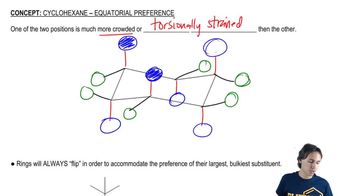
In cyclohexane, substituents can occupy two distinct positions: axial and equatorial. Axial substituents are oriented perpendicular to the plane of the ring, while equatorial substituents extend outward, parallel to the plane. The stability of these positions varies, with equatorial generally being more stable due to reduced steric hindrance and torsional strain.
추천 영상:
04:02
Equatorial Preference

Steric Hindrance

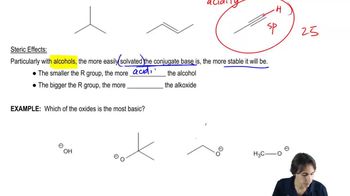
Steric hindrance refers to the repulsion between atoms that occurs when they are brought close together, particularly in bulky groups. In the context of cyclohexane, larger substituents like tert-butyl experience significant steric hindrance when in the axial position, leading to increased energy and instability compared to smaller groups like isopropyl, which can fit more comfortably in the axial position.
추천 영상:
02:53
Understanding steric effects.

Energy Differences in Conformations

The energy difference between axial and equatorial conformations is quantified in kJ/mol or kcal/mol. This difference arises from the steric interactions and torsional strain experienced by substituents in the axial position. For example, the tert-butyl group has a much larger energy difference due to its size, resulting in a more significant preference for the equatorial position compared to smaller groups like isopropyl.
추천 영상:
09:00
Explaining how A-Values are related to cyclohexane flip energy