Ch.3 - Structure and Stereochemistry of Alkanes
Wade - Organic Chemistry 9th Edition
Wade9th EditionOrganic ChemistryISBN: 9780135213728당신이 사용하는 게 아니라요?교과서 변경
3장, 문제 20

trans-1,2-Dimethylcyclobutane is more stable than cis-1,2-dimethylcyclobutane, but cis-1,3-dimethylcyclobutane is more stable than trans-1,3-dimethylcyclobutane. Use drawings to explain these observations.

검증된 단계별 안내
1
Understand the problem: The stability of cyclobutanes is influenced by steric strain and torsional strain. In this case, the relative stability of cis and trans isomers depends on the positions of the substituents (methyl groups) and their interactions within the ring structure.
Analyze the first case (1,2-dimethylcyclobutane): In the trans isomer, the two methyl groups are on opposite sides of the ring, reducing steric interactions between them. In the cis isomer, the two methyl groups are on the same side of the ring, leading to increased steric strain due to their close proximity.
Analyze the second case (1,3-dimethylcyclobutane): In the cis isomer, the two methyl groups are positioned on the same side of the ring but are farther apart (1,3 relationship), minimizing steric interactions. In the trans isomer, the methyl groups are on opposite sides of the ring but are positioned closer together, leading to increased steric strain.
Consider the role of ring puckering: Cyclobutane rings are not planar; they adopt a puckered conformation to reduce torsional strain. This puckering can influence the spatial arrangement of substituents and their interactions, further affecting stability.
Summarize the observations: The stability differences arise from the balance of steric strain and torsional strain. For 1,2-dimethylcyclobutane, the trans isomer is more stable due to reduced steric strain. For 1,3-dimethylcyclobutane, the cis isomer is more stable because the substituents are farther apart, reducing steric interactions.

비슷한 문제에 대한 검증된 영상 답변:

이 영상 해법은 위 문제에 도움이 된다고 튜터들이 추천한 것입니다.
영상 길이:
8m

주요 개념

질문에 올바르게 답하기 위해 반드시 이해해야 하는 핵심 개념들은 다음과 같습니다.

Steric Strain

Steric strain occurs when atoms are forced closer together than their natural bond lengths, leading to increased repulsion between electron clouds. In cycloalkanes, substituents can create steric strain when they are positioned in close proximity, particularly in the cis configuration, which can destabilize the molecule. Understanding steric strain is crucial for analyzing the stability of different isomers.
추천 영상:
02:00
What is torsional strain?

Torsional Strain

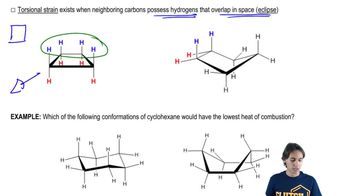
Torsional strain arises from the eclipsing interactions between atoms or groups in a molecule, particularly in cyclic structures. In cyclobutanes, the arrangement of substituents can lead to varying degrees of torsional strain depending on their positions (cis or trans). This strain affects the overall stability of the molecule, making it essential to consider when comparing isomers.
추천 영상:
02:00
What is torsional strain?

Conformational Analysis

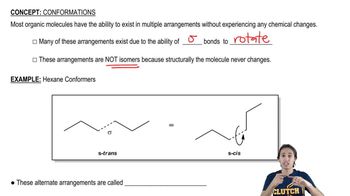
Conformational analysis involves studying the different spatial arrangements of a molecule that can be achieved by rotation around single bonds. In cycloalkanes, the conformations can significantly influence the stability of isomers. By visualizing and drawing these conformations, one can better understand how the positioning of substituents affects steric and torsional strain, leading to differences in stability.
추천 영상:
03:29
Understanding what a conformer is.