Ch.4 - The Study of Chemical Reactions
Wade - Organic Chemistry 9th Edition
Wade9th EditionOrganic ChemistryISBN: 9780135213728당신이 사용하는 게 아니라요?교과서 변경
4장, 문제 43(1)c,d

For each alkane,
1. draw all the possible monochlorinated derivatives.
c. 2-methylpentane
d. 2,2,3,3-tetramethyl butane

검증된 단계별 안내
1
Step 1: Understand the concept of monochlorination. Monochlorination involves replacing one hydrogen atom in the alkane with a chlorine atom. This process can occur at any carbon atom in the molecule, depending on the number of hydrogens attached to each carbon.
Step 2: Analyze the structure of 2-methylpentane. This molecule consists of a pentane chain with a methyl group attached to the second carbon. Identify all unique carbon atoms in the structure and determine the number of hydrogens attached to each carbon. This will help you identify the possible sites for chlorination.
Step 3: Draw the monochlorinated derivatives for 2-methylpentane. Replace one hydrogen atom at each unique carbon position with a chlorine atom. Ensure that you account for all unique positions, considering the symmetry of the molecule. Label each derivative clearly.
Step 4: Analyze the structure of 2,2,3,3-tetramethylbutane. This molecule consists of a butane chain with four methyl groups attached to the second and third carbons. Identify all unique carbon atoms and determine the number of hydrogens attached to each carbon. This will help you identify the possible sites for chlorination.
Step 5: Draw the monochlorinated derivatives for 2,2,3,3-tetramethylbutane. Replace one hydrogen atom at each unique carbon position with a chlorine atom. Due to the high degree of symmetry in this molecule, there will be fewer unique derivatives compared to 2-methylpentane. Label each derivative clearly.

비슷한 문제에 대한 검증된 영상 답변:

이 영상 해법은 위 문제에 도움이 된다고 튜터들이 추천한 것입니다.
영상 길이:
6m

주요 개념

질문에 올바르게 답하기 위해 반드시 이해해야 하는 핵심 개념들은 다음과 같습니다.

Alkanes

Alkanes are saturated hydrocarbons consisting only of carbon and hydrogen atoms, connected by single bonds. They follow the general formula CnH2n+2, where 'n' is the number of carbon atoms. Understanding the structure and properties of alkanes is essential for predicting their reactivity, particularly in substitution reactions like chlorination.
추천 영상:
02:47
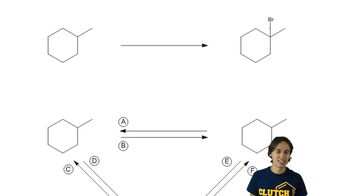
Functionalizing Alkanes

Chlorination Reaction

Chlorination is a type of substitution reaction where a hydrogen atom in an alkane is replaced by a chlorine atom. This reaction typically occurs in the presence of UV light or heat, leading to the formation of various chlorinated derivatives. Recognizing the mechanism and products of chlorination is crucial for determining all possible monochlorinated derivatives of a given alkane.
추천 영상:
03:
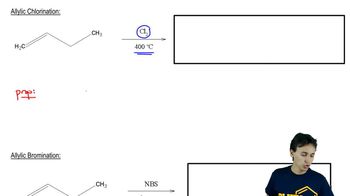
Specific Reactions - Allylic Chlorination

Isomerism

Isomerism refers to the existence of compounds with the same molecular formula but different structural arrangements. In the context of chlorinated alkanes, isomerism is significant because different positions of chlorine substitution can lead to distinct isomers. Understanding isomerism helps in identifying and drawing all possible monochlorinated derivatives for complex alkanes like 2-methylpentane and 2,2,3,3-tetramethylbutane.
추천 영상:
06:47
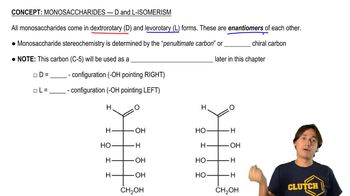
Monosaccharides - D and L Isomerism