Ch.5 - Stereochemistry
Wade - Organic Chemistry 9th Edition
Wade9th EditionOrganic ChemistryISBN: 9780135213728당신이 사용하는 게 아니라요?교과서 변경
5장, 문제 5

Draw a Fischer projection for each compound. Remember that the cross represents an asymmetric carbon atom, and the carbon chain should be along the vertical, with the IUPAC numbering from top to bottom. c. (S)-1,2-dibromobutane d. (R)-butan-2-ol

검증된 단계별 안내
1
Identify the chiral centers in each compound. For (S)-1,2-dibromobutane, the chiral center is at carbon 2. For (R)-butan-2-ol, the chiral center is also at carbon 2.
Draw the carbon chain vertically for each compound, with the highest priority group at the top according to IUPAC numbering. For both compounds, the carbon chain is butane, so it will have four carbon atoms.
For (S)-1,2-dibromobutane, place the bromine atoms on carbon 1 and carbon 2. Ensure that the configuration at carbon 2 is S by arranging the substituents in the correct order of priority (Br > CH2Br > CH3 > H) and using the Cahn-Ingold-Prelog rules.
For (R)-butan-2-ol, place the hydroxyl group (OH) on carbon 2. Ensure that the configuration at carbon 2 is R by arranging the substituents in the correct order of priority (OH > CH3 > CH2CH3 > H) and using the Cahn-Ingold-Prelog rules.
Convert the 3D arrangement of substituents at the chiral centers into a Fischer projection, ensuring that horizontal lines represent bonds coming out of the plane (towards the viewer) and vertical lines represent bonds going behind the plane (away from the viewer).

비슷한 문제에 대한 검증된 영상 답변:

이 영상 해법은 위 문제에 도움이 된다고 튜터들이 추천한 것입니다.
영상 길이:
8m
도움이 되었나요?

주요 개념

질문에 올바르게 답하기 위해 반드시 이해해야 하는 핵심 개념들은 다음과 같습니다.

Fischer Projections

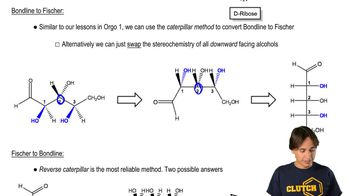
Fischer projections are a two-dimensional representation of three-dimensional organic molecules, particularly useful for depicting stereochemistry. In these diagrams, vertical lines represent bonds that project behind the plane of the page, while horizontal lines represent bonds that project out of the page. This format is especially important for visualizing chiral centers and understanding the spatial arrangement of substituents around them.
추천 영상:
가이드 코스
09:56
Monosaccharides - Drawing Fischer Projections

Chirality and Stereochemistry

Chirality refers to the property of a molecule that makes it non-superimposable on its mirror image, often due to the presence of asymmetric carbon atoms. Stereochemistry is the study of the spatial arrangement of atoms in molecules and how this affects their chemical behavior. Understanding the (R) and (S) nomenclature is crucial for accurately representing the configuration of chiral centers in compounds like (S)-1,2-dibromobutane and (R)-butan-2-ol.
추천 영상:
1:21
Polymer Stereochemistry Example 1

IUPAC Nomenclature

The International Union of Pure and Applied Chemistry (IUPAC) nomenclature provides a systematic way to name organic compounds based on their structure. It includes rules for identifying the longest carbon chain, numbering the carbon atoms, and naming substituents. For example, in (S)-1,2-dibromobutane, the '1,2' indicates the positions of the bromine substituents on the butane chain, which is essential for constructing the correct Fischer projection.
추천 영상:
가이드 코스
03:43
The different parts of an IUPAC name
관련 실천
교과서 질문
To show that (R)-2-butyl (R,R)-tartrate and (S)-2-butyl (R,R)-tartrate are not enantiomers, draw and name the mirror images of these compounds.
1038
views
교과서 질문
Draw a three-dimensional structure for each compound, and star all asymmetric carbon atoms. Draw the mirror image for each structure, and state whether you have drawn a pair of enantiomers or just the same molecule twice. Build molecular models of any of these examples that seem difficult to you e. Chlorocyclohexane f. Cis-1,2-dichlorocyclobutane
1484
views
교과서 질문
For each compound, determine whether the molecule has an internal mirror plane of symmetry. If it does, draw the mirror plane on a three-dimensional drawing of the molecule. If the molecule does not have an internal mirror plane, determine whether the structure is chiral. a. Methane b. cis-1,2-dibromocyclobutane c. trans-1,2-dibromocyclobutane
1537
views
교과서 질문
Draw three-dimensional representations of the following compounds. Which have asymmetric carbon atoms? Which have no asymmetric carbons but are chiral anyway? Use your models for parts (a) through (d) and any others that seem unclear. c. ClHC═C═C(CH3)2 1-chloro-3-methylbuta-1,2-diene d. ClHC═CH―CH═CH2 1-chlorobuta-1,3-diene
1294
views
교과서 질문
In Problem 5-3 , you drew the enantiomers for a number of chiral compounds. Now go back and designate each asymmetric carbon atom as either (R) or (S). e. Chlorocyclohexane f. Cis-1,2-dichlorocyclobutane
1201
views
교과서 질문
Make a model and draw a three-dimensional structure for each compound. Then draw the mirror image of your original structure and determine whether the mirror image is the same compound. Label each structure as being chiral or achiral, and label pairs of enantiomers. a. cis-1,2-dimethylcyclobutane b. trans-1,2-dimethylcyclobutane
703
views