Ch.5 - Stereochemistry
Wade - Organic Chemistry 9th Edition
Wade9th EditionOrganic ChemistryISBN: 9780135213728당신이 사용하는 게 아니라요?교과서 변경
5장, 문제 19a,b

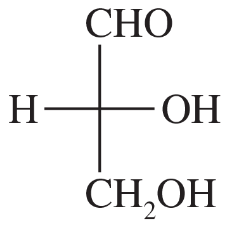
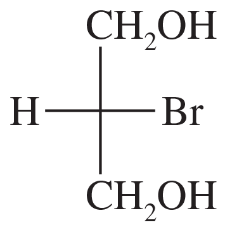
For each Fischer projection, label each asymmetric carbon atom as (R) or (S).
(a)
(b)

검증된 단계별 안내
1
Step 1: Identify the asymmetric carbon atoms in each Fischer projection. An asymmetric carbon is bonded to four different groups. For structure (a), the central carbon is asymmetric as it is bonded to CHO, CH2OH, H, and OH. For structure (b), the central carbon is asymmetric as it is bonded to CH2OH, CH2OH, H, and Br.
Step 2: Assign priorities to the substituents attached to the asymmetric carbon based on the Cahn-Ingold-Prelog (CIP) rules. The priority is determined by atomic number: higher atomic numbers get higher priority. For structure (a), the priorities are: CHO (1), OH (2), CH2OH (3), H (4). For structure (b), the priorities are: Br (1), CH2OH (2), CH2OH (3), H (4).
Step 3: Orient the molecule so that the lowest priority group (H) is pointing away from you. In a Fischer projection, the vertical bonds are considered to be pointing away from the viewer, and the horizontal bonds are pointing toward the viewer.
Step 4: Determine the order of the remaining substituents (1 → 2 → 3) in a clockwise or counterclockwise direction. If the order is clockwise, the configuration is (R). If the order is counterclockwise, the configuration is (S).
Step 5: Label the asymmetric carbon atoms in each structure as (R) or (S) based on the analysis from Step 4. Ensure the configuration is consistent with the orientation of the molecule in the Fischer projection.

비슷한 문제에 대한 검증된 영상 답변:

이 영상 해법은 위 문제에 도움이 된다고 튜터들이 추천한 것입니다.
영상 길이:
6m
도움이 되었나요?

주요 개념

질문에 올바르게 답하기 위해 반드시 이해해야 하는 핵심 개념들은 다음과 같습니다.

Fischer Projections

Fischer projections are a two-dimensional representation of three-dimensional organic molecules, particularly useful for depicting stereochemistry. In these diagrams, vertical lines represent bonds that project away from the viewer, while horizontal lines represent bonds that project towards the viewer. This format is essential for identifying chiral centers and determining the configuration of stereoisomers.
추천 영상:
09:56
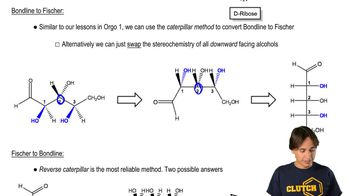
Monosaccharides - Drawing Fischer Projections

Chirality and Asymmetric Carbon Atoms

Chirality refers to the property of a molecule that makes it non-superimposable on its mirror image, often due to the presence of asymmetric carbon atoms. An asymmetric carbon atom, or chiral center, is bonded to four different substituents, leading to two possible configurations: (R) for rectus (right) and (S) for sinister (left). Identifying these centers is crucial for understanding the molecule's stereochemistry.
추천 영상:
05:41
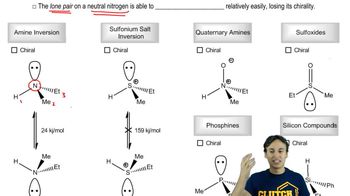
Understanding Other Chiral Atoms

Cahn-Ingold-Prelog Priority Rules

The Cahn-Ingold-Prelog (CIP) priority rules are a systematic method for assigning (R) or (S) configurations to chiral centers in organic molecules. According to these rules, substituents attached to the chiral carbon are ranked based on atomic number, with higher atomic numbers receiving higher priority. The configuration is determined by the orientation of the substituents when the lowest priority group is oriented away from the viewer.
추천 영상:
01:48
Why stereoisomers need their own naming system.