
Ch.5 - Stereochemistry
Wade - Organic Chemistry 9th Edition
Wade9th EditionOrganic ChemistryISBN: 9780135213728당신이 사용하는 게 아니라요?교과서 변경
5장, 문제 26g,h

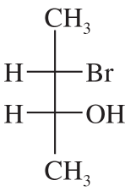
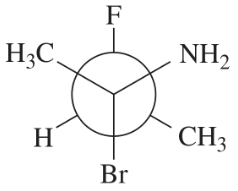
For each structure,
1. star (*) any asymmetric carbon atoms.
2. label each asymmetric carbon as (R) or (S).
3. draw any internal mirror planes of symmetry.
4. label the structure as chiral or achiral.
5. label any meso structures.
(g)
(h)

검증된 단계별 안내
1
Step 1: Identify asymmetric carbon atoms in each structure. An asymmetric carbon is a carbon atom bonded to four different groups. For structure (g), examine each carbon atom to determine if it is bonded to four distinct substituents. For structure (h), repeat the process for each carbon atom.
Step 2: Mark each asymmetric carbon atom with a star (*) in both structures. For structure (g), the asymmetric carbons are the ones bonded to Br, OH, H, and CH3 groups. For structure (h), identify the asymmetric carbons based on their substituents (e.g., Br, F, NH2, CH3, H).
Step 3: Assign the configuration (R or S) to each asymmetric carbon atom using the Cahn-Ingold-Prelog priority rules. Assign priorities to the substituents based on atomic number, orient the molecule so the lowest priority group is pointing away, and determine the order of the remaining groups (clockwise for R, counterclockwise for S).
Step 4: Check for internal mirror planes of symmetry in each structure. If a structure has a plane of symmetry, it is achiral. For structure (g), examine whether the molecule has symmetry. For structure (h), check for symmetry in the tetrahedral arrangement.
Step 5: Determine if the structure is chiral or achiral and label any meso structures. A meso compound is achiral despite having asymmetric carbons due to internal symmetry. For structure (g), check if it is meso. For structure (h), determine if it is chiral or achiral based on symmetry and substituent arrangement.

비슷한 문제에 대한 검증된 영상 답변:

이 영상 해법은 위 문제에 도움이 된다고 튜터들이 추천한 것입니다.
영상 길이:
9m
도움이 되었나요?

주요 개념

질문에 올바르게 답하기 위해 반드시 이해해야 하는 핵심 개념들은 다음과 같습니다.

Asymmetric Carbon Atoms

Asymmetric carbon atoms, or chiral centers, are carbon atoms that are bonded to four different substituents. This unique arrangement allows for the existence of non-superimposable mirror images, known as enantiomers. Identifying these centers is crucial for determining the chirality of a molecule.
추천 영상:
01:44
The difference between atomic numbers and atomic mass.

Cahn-Ingold-Prelog Priority Rules

The Cahn-Ingold-Prelog (CIP) priority rules are used to assign the configuration of chiral centers as either (R) or (S). This system ranks the substituents attached to the chiral carbon based on atomic number, with higher atomic numbers receiving higher priority. The configuration is determined by the orientation of the substituents when the lowest priority group is positioned away from the viewer.
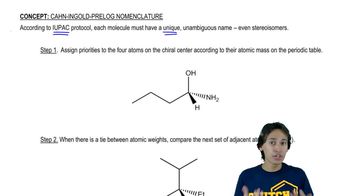
추천 영상:
01:48
Why stereoisomers need their own naming system.

Chirality and Meso Compounds

Chirality refers to the property of a molecule that is not superimposable on its mirror image, indicating that it has a distinct left and right form. Meso compounds, however, are a special case where a molecule has multiple chiral centers but is overall achiral due to an internal plane of symmetry. Recognizing these characteristics is essential for labeling structures correctly.
추천 영상:
04:10
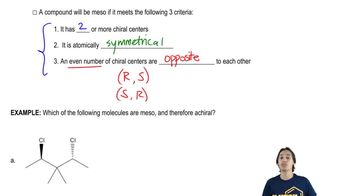
The 3 rules of meso compounds.
관련 실천
교과서 질문

For each structure,

1. star (*) any asymmetric carbon atoms.

2. label each asymmetric carbon as (R) or (S).

3. draw any internal mirror planes of symmetry.

4. label the structure as chiral or achiral.

5. label any meso structures.

(f)

652
views
교과서 질문

Convert the following perspective formulas to Fischer projections.

(a)

(b)

3170
views
교과서 질문

For each structure,

1. star (*) any asymmetric carbon atoms.

2. label each asymmetric carbon as (R) or (S).

3. draw any internal mirror planes of symmetry.

4. label the structure as chiral or achiral.

5. label any meso structures.

(e)

1060
views
교과서 질문

For each of the compounds described by the following names,

1. draw a three-dimensional representation.

2. star (*) each chiral center.

3. draw any planes of symmetry.

4. draw any enantiomer.

5. draw any diastereomers.

6. label each structure you have drawn as chiral or achiral.

a. (S)-2-chlorobutane

b. (R)-1,1,2-trimethylcyclohexane

957
views
교과서 질문

For each structure,

1. star (*) any asymmetric carbon atoms.

2. label each asymmetric carbon as (R) or (S).

3. draw any internal mirror planes of symmetry.

4. label the structure as chiral or achiral.

5. label any meso structures.

(a)

(b)

2663
views
1
rank
교과서 질문

For each of the compounds described by the following names,

1. draw a three-dimensional representation.

2. star (*) each chiral center.

3. draw any planes of symmetry.

4. draw any enantiomer.

5. draw any diastereomers.

6. label each structure you have drawn as chiral or achiral.

c. (2R,3S)-2,3-dibromohexane

d. (1R,2R)-1,2-dibromocyclohexane

1261
views