Ch. 7 - Structure and Synthesis of Alkenes; Elimination
Wade - Organic Chemistry 9th Edition
Wade9th EditionOrganic ChemistryISBN: 9780135213728당신이 사용하는 게 아니라요?교과서 변경
7장, 문제 30a

Two stereoisomers of a bromodecalin are shown. Although the difference between these stereoisomers may seem trivial, one isomer undergoes elimination with KOH much faster than the other. Predict the products of these eliminations, and explain the large difference in the ease of elimination.
Two stereoisomers of bromodecalin, labeled for fast and slow elimination reactions with KOH.

검증된 단계별 안내
1
Step 1: Analyze the stereochemistry of the two bromodecalin isomers. In the first isomer (fast elimination), the bromine atom is in the axial position, while in the second isomer (slow elimination), the bromine atom is in the equatorial position.
Step 2: Recall the requirements for elimination reactions, specifically the E2 mechanism. The E2 mechanism requires a coplanar arrangement of the β-hydrogen and the leaving group (anti-periplanar geometry). This geometry is more easily achieved when the leaving group is in the axial position.
Step 3: In the fast elimination isomer, the axial bromine and the axial β-hydrogen on the adjacent carbon are anti-periplanar, making elimination via the E2 mechanism highly favorable. This leads to the formation of a double bond in the product.
Step 4: In the slow elimination isomer, the equatorial bromine and the β-hydrogen are not anti-periplanar. This misalignment makes elimination via the E2 mechanism less favorable, resulting in a slower reaction rate.
Step 5: Predict the products of elimination for both isomers. For the fast elimination isomer, the product will be a double bond formed between the two carbons involved in the elimination. For the slow elimination isomer, the same product will form, but the reaction will proceed at a slower rate due to the unfavorable geometry.

비슷한 문제에 대한 검증된 영상 답변:

이 영상 해법은 위 문제에 도움이 된다고 튜터들이 추천한 것입니다.
영상 길이:
8m
도움이 되었나요?

주요 개념

질문에 올바르게 답하기 위해 반드시 이해해야 하는 핵심 개념들은 다음과 같습니다.

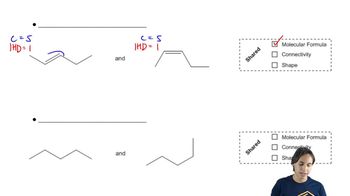
Stereoisomerism

Stereoisomerism refers to the phenomenon where compounds have the same molecular formula and connectivity of atoms but differ in the spatial arrangement of their atoms. In organic chemistry, stereoisomers can be classified into enantiomers and diastereomers, which can exhibit different chemical reactivities due to their distinct three-dimensional shapes. Understanding stereoisomerism is crucial for predicting the behavior of molecules in reactions, such as elimination.
추천 영상:
01:58
Determining when molecules are stereoisomers.

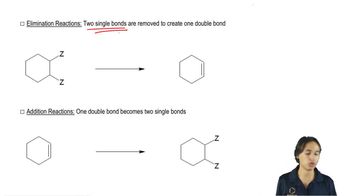
Elimination Reactions

Elimination reactions involve the removal of a small molecule from a larger one, typically resulting in the formation of a double bond. In the context of the question, the elimination of bromine from bromodecalin with KOH leads to the formation of alkenes. The rate of elimination can vary significantly between stereoisomers due to factors such as steric hindrance and the stability of the resulting alkene, which are influenced by the spatial arrangement of substituents.
추천 영상:
00:40
Recognizing Elimination Reactions.

Zaitsev's Rule

Zaitsev's Rule states that in elimination reactions, the more substituted alkene product is favored due to its greater stability. This principle is particularly relevant when predicting the products of elimination reactions, as the stability of the alkene formed can influence the reaction rate. In the case of the bromodecalin stereoisomers, the faster elimination may lead to a more stable alkene, while the slower one may produce a less stable product, highlighting the importance of molecular structure in reaction outcomes.
추천 영상:
01:18
Defining Zaitsev’s Rule