Ch. 7 - Structure and Synthesis of Alkenes; Elimination
Wade - Organic Chemistry 9th Edition
Wade9th EditionOrganic ChemistryISBN: 9780135213728당신이 사용하는 게 아니라요?교과서 변경
7장, 문제 42c,d

Determine which compounds show cis-trans isomerism. Draw and label the isomers, using both the cis-trans and E-Z nomenclatures where applicable.
c. hex-3-ene
d. 1,1-dibromopropene

검증된 단계별 안내
1
Step 1: Understand the concept of cis-trans isomerism. Cis-trans isomerism occurs in alkenes where there are two different groups attached to each carbon of the double bond. The 'cis' isomer has the same groups on the same side of the double bond, while the 'trans' isomer has them on opposite sides.
Step 2: Analyze hex-3-ene. Hex-3-ene is an alkene with a double bond between the third and fourth carbon atoms in a six-carbon chain. Check if the groups attached to the double-bonded carbons allow for cis-trans isomerism. Use MathML to represent the structure: C3=C4.
Step 3: Draw and label the isomers for hex-3-ene. If cis-trans isomerism is possible, draw the 'cis' isomer with similar groups on the same side and the 'trans' isomer with similar groups on opposite sides. Use E-Z nomenclature if the groups are different in priority according to Cahn-Ingold-Prelog rules.
Step 4: Analyze 1,1-dibromopropene. This compound has a double bond between the first and second carbon atoms, with two bromine atoms attached to the first carbon. Since both bromine atoms are on the same carbon, cis-trans isomerism is not possible. Use MathML to represent the structure: C1=C2.
Step 5: Conclude which compounds show cis-trans isomerism. Hex-3-ene can exhibit cis-trans isomerism due to the different groups attached to the double-bonded carbons, while 1,1-dibromopropene cannot due to identical groups on one carbon.

비슷한 문제에 대한 검증된 영상 답변:

이 영상 해법은 위 문제에 도움이 된다고 튜터들이 추천한 것입니다.
영상 길이:
5m

주요 개념

질문에 올바르게 답하기 위해 반드시 이해해야 하는 핵심 개념들은 다음과 같습니다.

Cis-Trans Isomerism

Cis-trans isomerism, also known as geometric isomerism, occurs in alkenes where two different groups are attached to each carbon of the double bond. In the 'cis' isomer, similar groups are on the same side, while in the 'trans' isomer, they are on opposite sides. This type of isomerism is crucial for understanding the spatial arrangement of molecules and their chemical properties.
추천 영상:
00:44
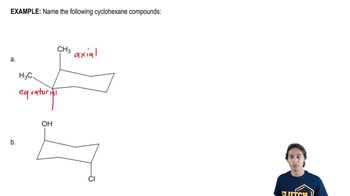
Is the following cyclohexane cis or trans?

E-Z Nomenclature

E-Z nomenclature is a more comprehensive system for describing the stereochemistry of double bonds, especially when more than two different substituents are present. 'E' (from the German 'entgegen') indicates that the higher priority groups are on opposite sides, while 'Z' (from 'zusammen') means they are on the same side. Priority is determined by the Cahn-Ingold-Prelog rules, which consider atomic number and connectivity.
추천 영상:
03:48
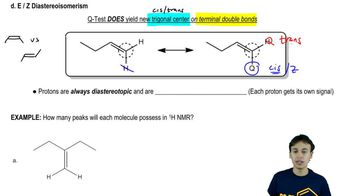
E/Z Diastereoisomerism

Alkene Structure and Substitution

The structure of alkenes, characterized by a carbon-carbon double bond, is pivotal in determining their ability to exhibit isomerism. For cis-trans isomerism to occur, each carbon in the double bond must have two different substituents. In hex-3-ene, the double bond is between the third and fourth carbon, allowing for isomerism, while in 1,1-dibromopropene, the substituents on one carbon are identical, preventing cis-trans isomerism.
추천 영상:
가이드 코스
2:09
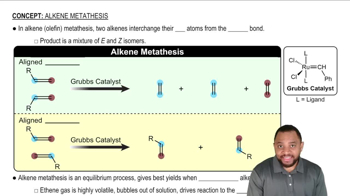
Alkene Metathesis Concept 1