Ch. 7 - Structure and Synthesis of Alkenes; Elimination
Wade - Organic Chemistry 9th Edition
Wade9th EditionOrganic ChemistryISBN: 9780135213728당신이 사용하는 게 아니라요?교과서 변경
7장, 문제 70

Explain the dramatic difference in rotational energy barriers of the following three alkenes. (Hint: Consider what the transition states must look like.)

검증된 단계별 안내
1
Step 1: Analyze the structures of the alkenes provided. The first alkene has no substituents, the second has phenyl groups, and the third has ester and amine groups. Consider how these substituents might affect the rotational energy barrier.
Step 2: Consider the steric hindrance in each alkene. The first alkene has the highest rotational energy barrier due to the lack of substituents, which means there is no steric hindrance to stabilize the transition state. The second alkene has phenyl groups that can provide some stabilization through conjugation, lowering the energy barrier.
Step 3: Evaluate the electronic effects of the substituents. The third alkene has ester and amine groups, which can participate in resonance and hyperconjugation, significantly stabilizing the transition state and thus lowering the rotational energy barrier.
Step 4: Consider the transition states for each alkene. The transition state for the first alkene is less stable due to the absence of substituents. The second alkene's transition state is stabilized by the phenyl groups through π-conjugation. The third alkene's transition state is highly stabilized by resonance effects from the ester and amine groups.
Step 5: Conclude that the dramatic difference in rotational energy barriers is due to the varying degrees of steric and electronic stabilization provided by the substituents in each alkene. The more substituents that can stabilize the transition state, the lower the rotational energy barrier.

비슷한 문제에 대한 검증된 영상 답변:

이 영상 해법은 위 문제에 도움이 된다고 튜터들이 추천한 것입니다.
영상 길이:
11m

주요 개념

질문에 올바르게 답하기 위해 반드시 이해해야 하는 핵심 개념들은 다음과 같습니다.

Rotational Energy Barriers

Rotational energy barriers refer to the energy required to rotate around a double bond in alkenes. This energy is influenced by steric hindrance and electronic effects, which can stabilize or destabilize the transition state during rotation. A higher barrier indicates greater resistance to rotation, often due to bulky substituents or unfavorable interactions in the transition state.
추천 영상:
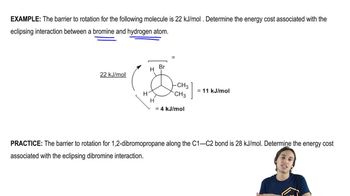
03:00
Determining energy cost of eclipsed interaction

Transition States

Transition states are high-energy configurations that occur during the conversion of reactants to products in a chemical reaction. In the context of alkenes, the transition state during rotation involves the alignment of substituents around the double bond. The stability of this state is crucial in determining the rotational energy barrier, as more stable transition states correspond to lower energy barriers.
추천 영상:
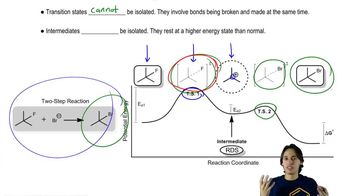
06:55
Intermediates vs. Transition States

Steric Hindrance

Steric hindrance refers to the repulsion between bulky groups in a molecule that can impede certain reactions or conformational changes. In alkenes, larger substituents can create significant steric strain when attempting to rotate around the double bond, leading to higher rotational energy barriers. Understanding steric effects is essential for predicting the stability and reactivity of different alkene isomers.
추천 영상:
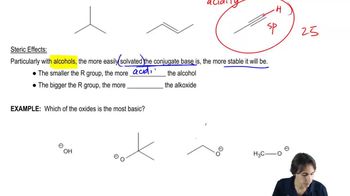
02:53
Understanding steric effects.
관련 실천
교과서 질문

When 2-bromo-3-phenylbutane is treated with sodium methoxide, two alkenes result (by E2 elimination). The Zaitsev product predominates.

a. Draw the reaction, showing the major and minor products.

1666
views

교과서 질문

Write a mechanism that explains the formation of the following product. In your mechanism, explain the cause of the rearrangement, and explain the failure to form the Zaitsev product.

962
views
교과서 질문

One of the following dichloronorbornanes undergoes elimination much faster than the other. Determine which one reacts faster, and explain the large difference in rates.

1057
views
교과서 질문

The following reaction is called the pinacol rearrangement. The reaction begins with an acid-promoted ionization to give a carbocation. This carbocation undergoes a methyl shift to give a more stable, resonance-stabilized cation. Loss of a proton gives the observed product. Propose a mechanism for the pinacol rearrangement.

1787
views
교과서 질문

When (±)−2,3−dibromobutane reacts with potassium hydroxide, some of the products are (2S,3R)-3-bromobutan-2-ol and its enantiomer and trans-2-bromobut-2-ene. Why is no cis-2-bromobut-2-ene formed?

972
views
교과서 질문

When 2-bromo-3-phenylbutane is treated with sodium methoxide, two alkenes result (by E2 elimination). The Zaitsev product predominates.

b. When one pure stereoisomer of 2-bromo-3-phenylbutane reacts, one pure stereoisomer of the major product results. For example, when (2R,3R)-2-bromo-3-phenylbutane reacts, the product is the stereoisomer with the methyl groups cis. Use your models to draw a Newman projection of the transition state to show why this stereospecificity is observed.

c. Use a Newman projection of the transition state to predict the major product of elimination of (2S,3R)-2-bromo-3-phenylbutane.

d. Predict the major product from elimination of (2S,3S)-2-bromo-3-phenylbutane. This prediction can be made without drawing any structures, by considering the results in part (b).

2591
views
1
comments