
Show that the (S,S) enantiomer of this (R,R) diastereomer of 1-bromo-1,2-diphenylpropane also undergoes E2 elimination to give the cis diastereomer of the product. (We do not expect these achiral reagents to distinguish between enantiomers.)
For each reaction, decide whether substitution or elimination (or both) is possible, and predict the products you expect. Label the major products.
a. 1−bromo−1−methylcyclohexane + NaOH in acetone
검증된 단계별 안내
비슷한 문제에 대한 검증된 영상 답변:
주요 개념
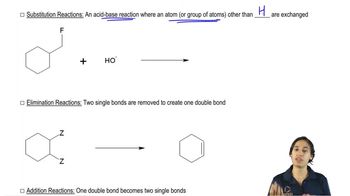
Substitution Reactions
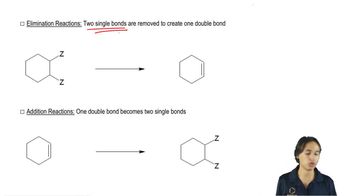
Elimination Reactions
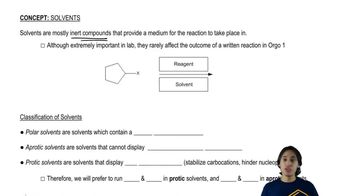
Reaction Conditions and Solvent Effects
Predict the elimination products of the following reactions. When two alkenes are possible, predict which one will be the major product. Explain your answers, showing the degree of substitution of each double bond in the products.
a. 2-bromopentane + NaOCH3
b. 3-bromo-3-methylpentane + NaOMe (Me = methyl,CH3)
c. 2-bromo-3-ethylpentane + NaOH
Which of these reactions are likely to produce both elimination and substitution products?
a. 2-bromopentane + NaOCH3
b. 3-bromo-3-methylpentane + NaOMe. (Me = methyl, CH3)
c. 2-bromo-3-ethylpentane + NaOH
For each reaction, decide whether substitution or elimination (or both) is possible, and predict the products you expect. Label the major products.
c. chlorocyclohexane+NaOCH3 in CH3OH
d. chlorocyclohexane + NaOC(CH3)3 in (CH3)3COH
Under second-order conditions (strong base/nucleophile), SN2 and E2 reactions may occur simultaneously and compete with each other. Show what products might be expected from the reaction of 2-bromo-3-methylbutane (a moderately hindered 2° alkyl halide) with sodium ethoxide.
Make models of the following compounds, and predict the products formed when they react with the strong bases shown.
(a)
