Ch. 7 - Structure and Synthesis of Alkenes; Elimination
Wade - Organic Chemistry 9th Edition
Wade9th EditionOrganic ChemistryISBN: 9780135213728당신이 사용하는 게 아니라요?교과서 변경
7장, 문제 37b

For practice in recognizing mechanisms, classify each reaction according to the type of mechanism you expect:
1. Free-radical chain reaction
2. Reaction involving strong bases and strong nucleophiles
3. Reaction involving strong acids and strong electrophiles
(b)

검증된 단계별 안내
1
Identify the type of reaction: The reaction involves an acid (H+) and water (H2O), which suggests an acid-catalyzed hydration mechanism.
Analyze the starting material: The starting compound is a cyclic ketone with an alkene group, indicating that the reaction may involve the addition of water across the double bond.
Protonation step: The acid (H+) will protonate the alkene, forming a more stable carbocation intermediate. This step is crucial as it activates the alkene for nucleophilic attack.
Nucleophilic attack: Water (H2O) acts as a nucleophile and attacks the carbocation, leading to the formation of an oxonium ion intermediate.
Deprotonation step: The oxonium ion is deprotonated by another water molecule, resulting in the formation of the final diol product, where two hydroxyl groups are added to the original alkene positions.

비슷한 문제에 대한 검증된 영상 답변:

이 영상 해법은 위 문제에 도움이 된다고 튜터들이 추천한 것입니다.
영상 길이:
1m
도움이 되었나요?

주요 개념

질문에 올바르게 답하기 위해 반드시 이해해야 하는 핵심 개념들은 다음과 같습니다.

Free-Radical Chain Reactions

Free-radical chain reactions involve a series of steps where free radicals are generated and react with stable molecules, leading to the formation of new radicals. These reactions typically include initiation, propagation, and termination phases. They are common in processes like polymerization and combustion, where the presence of heat or light can initiate the reaction.
추천 영상:
12:11
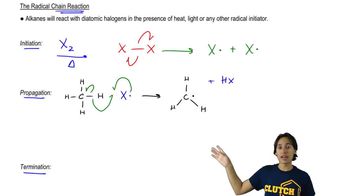
Radical Chain Reaction Mechanism.

Nucleophiles and Electrophiles

Nucleophiles are species that donate an electron pair to form a chemical bond, while electrophiles are electron-deficient species that accept an electron pair. Strong bases often act as nucleophiles, attacking electrophilic centers in molecules. Understanding the reactivity of these species is crucial for predicting the outcome of organic reactions, such as substitution and addition mechanisms.
추천 영상:
03:
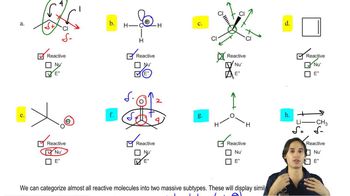
Nucleophile or Electrophile

Acid-Catalyzed Reactions

Acid-catalyzed reactions involve the use of acids to increase the rate of a reaction by protonating a reactant, making it more electrophilic. This mechanism is common in hydration reactions, where water adds to alkenes or carbonyl compounds. The presence of a strong acid facilitates the formation of carbocations, which are key intermediates in many organic transformations.
추천 영상:
03:09
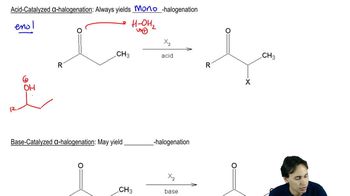
Acid Catalyzed
관련 실천
교과서 질문

Show the product(s) you expect from dehydration of the following alcohols when they are heated in sulfuric or phosphoric acid. In each case, use a mechanism to show how the products are formed.

(c)

697
views

교과서 질문

For practice in recognizing mechanisms, classify each reaction according to the type of mechanism you expect:

1. Free-radical chain reaction

2. Reaction involving strong bases and strong nucleophiles

3. Reaction involving strong acids and strong electrophiles

(c)

1526
views
교과서 질문

The dehydrogenation of butane to trans-but-2-ene has ΔH° = +116 kJ/mol (+27.6 kcal/mol) and ΔS° = +117J/kelvin-mol (+28.0 cal/kelvin-mol).

a. Compute the value of ΔG° for dehydrogenation at room temperature (25 °C or 298 °K). Is dehydrogenation favored or disfavored?

HINT: When you are doing synthesis problems, avoid using these high-temperature industrial methods. They require specialized equipment, and they produce variable mixtures of products.

1068
views
교과서 질문

Propose mechanisms for the following reactions. Additional products may be formed, but your mechanism only needs to explain the products shown.

(a)

(Hint: Hydride shift)

801
views
교과서 질문

For practice in recognizing mechanisms, classify each reaction according to the type of mechanism you expect:

1. Free-radical chain reaction

2. Reaction involving strong bases and strong nucleophiles

3. Reaction involving strong acids and strong electrophiles

(a)

1539
views
교과서 질문

For practice in recognizing mechanisms, classify each reaction according to the type of mechanism you expect:

1. Free-radical chain reaction

2. Reaction involving strong bases and strong nucleophiles

3. Reaction involving strong acids and strong electrophiles.

(d)

1435
views