Ch. 7 - Structure and Synthesis of Alkenes; Elimination
Wade - Organic Chemistry 9th Edition
Wade9th EditionOrganic ChemistryISBN: 9780135213728당신이 사용하는 게 아니라요?교과서 변경
7장, 문제 27c

Make models of the following compounds, and predict the products formed when they react with the strong bases shown.
(c) (d,l)-1,2-dibromo-1,2-diphenylethane + (CH3CH2)3N:

검증된 단계별 안내
1
Step 1: Analyze the structure of (d,l)-1,2-dibromo-1,2-diphenylethane. This compound contains two bromine atoms attached to adjacent carbon atoms (C1 and C2) in a 1,2-relationship. Each carbon also has a phenyl group (C6H5) attached, and the compound exists as a pair of enantiomers (d and l forms).
Step 2: Recall the mechanism of an E2 elimination reaction. E2 eliminations require a strong base (in this case, triethylamine, (CH3CH2)3N) and a β-hydrogen that is anti-coplanar to the leaving group (bromine). Anti-coplanar geometry is crucial for the reaction to proceed efficiently.
Step 3: Identify the β-hydrogens on the molecule. For each bromine atom, look at the adjacent carbon (the β-carbon) and determine if it has hydrogens that are anti-coplanar to the bromine. In this case, the β-hydrogens are located on the same carbons as the phenyl groups.
Step 4: Predict the product of the E2 elimination. When the β-hydrogens are removed along with the bromine atoms, a double bond will form between C1 and C2. The resulting product will be a trans-stilbene (E-1,2-diphenylethene), as the anti-coplanar geometry favors the formation of the trans isomer.
Step 5: Consider stereochemical constraints. Since the starting material is (d,l)-1,2-dibromo-1,2-diphenylethane, the reaction will proceed through the anti-coplanar pathway for each enantiomer, leading to the same trans-stilbene product. Syn-coplanar elimination is unlikely due to the rarity of this pathway and the free rotation around the single bonds.

비슷한 문제에 대한 검증된 영상 답변:

이 영상 해법은 위 문제에 도움이 된다고 튜터들이 추천한 것입니다.
영상 길이:
3m

주요 개념

질문에 올바르게 답하기 위해 반드시 이해해야 하는 핵심 개념들은 다음과 같습니다.

E2 Elimination Mechanism

The E2 elimination mechanism is a bimolecular reaction where a strong base abstracts a proton from a β-carbon, leading to the simultaneous removal of a leaving group from the α-carbon. This results in the formation of a double bond. The reaction is stereospecific, often requiring an anti-coplanar arrangement of the leaving group and the hydrogen being removed for optimal overlap of orbitals.
추천 영상:
09:36
Drawing the E2 Mechanism.

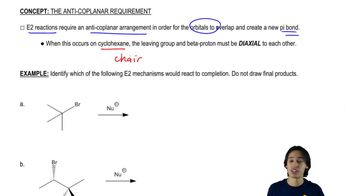
Anti-Coplanar vs. Syn-Coplanar

In E2 reactions, the terms anti-coplanar and syn-coplanar refer to the spatial arrangement of atoms involved in the elimination process. Anti-coplanar configurations, where the leaving group and the hydrogen are on opposite sides, are favored and lead to more stable products. In contrast, syn-coplanar configurations, where these groups are on the same side, are less common and typically occur when rotation around a bond is restricted.
추천 영상:
03:19
The Anti-Coplanar Requirement

Steric Hindrance and Conformational Analysis

Steric hindrance refers to the repulsion between bulky groups in a molecule that can affect reactivity and product formation. In conformational analysis, understanding the spatial arrangement of atoms in a molecule is crucial, especially in determining whether a compound can adopt the necessary geometry for E2 elimination. This analysis helps predict whether the reaction will proceed via an anti-coplanar or syn-coplanar pathway.
추천 영상:
03:29
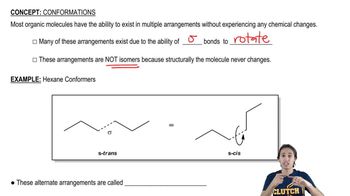
Understanding what a conformer is.