Ch. 7 - Structure and Synthesis of Alkenes; Elimination
Wade - Organic Chemistry 9th Edition
Wade9th EditionOrganic ChemistryISBN: 9780135213728당신이 사용하는 게 아니라요?교과서 변경
7장, 문제 61b

Propose mechanisms for the following reactions. Additional products may be formed, but your mechanism only needs to explain the products shown.
(b) Chemical reaction diagram showing dehydration of an alcohol to form alkenes and additional products.

검증된 단계별 안내
1
Step 1: Protonation of the alcohol group - The reaction begins with the protonation of the hydroxyl group (-OH) on the cyclopentylmethanol molecule by sulfuric acid (H₂SO₄). This forms a good leaving group, water (H₂O), and converts the alcohol into a positively charged intermediate.
Step 2: Formation of a carbocation - The water molecule leaves, resulting in the formation of a carbocation at the benzylic position (the carbon attached to the cyclopentane ring). This carbocation is stabilized due to its proximity to the ring structure.
Step 3: Elimination to form alkenes - The carbocation undergoes elimination reactions to form the observed alkene products. A β-hydrogen is removed from adjacent carbons, leading to the formation of double bonds. This results in the formation of cyclopentene and methylenecyclopentane as products.
Step 4: Rearrangement to form cyclohexene - The carbocation can undergo a ring expansion via a hydride or alkyl shift, leading to the formation of a six-membered ring. This rearrangement results in the formation of cyclohexene as an additional product.
Step 5: Final products - The reaction yields three products: cyclopentene, methylenecyclopentane, and cyclohexene. These products are formed through elimination and rearrangement mechanisms facilitated by the acidic conditions and heat.

비슷한 문제에 대한 검증된 영상 답변:

이 영상 해법은 위 문제에 도움이 된다고 튜터들이 추천한 것입니다.
영상 길이:
7m

주요 개념

질문에 올바르게 답하기 위해 반드시 이해해야 하는 핵심 개념들은 다음과 같습니다.

Acid-Base Reactions

Acid-base reactions are fundamental in organic chemistry, where an acid donates a proton (H+) and a base accepts it. In the context of the given reaction involving H2SO4, a strong acid, understanding how protons are transferred is crucial for predicting the formation of products. This concept helps in identifying the reactive sites in molecules and the resulting changes in their structure.
추천 영상:
02:49
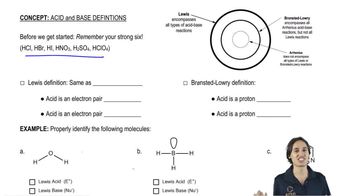
The Lewis definition of acids and bases.

Reaction Mechanisms

A reaction mechanism outlines the step-by-step sequence of elementary reactions that lead to the formation of products. It is essential to propose a mechanism for the reactions shown, as it provides insight into the intermediates formed and the transition states involved. Understanding mechanisms allows chemists to predict the outcome of reactions and the stability of intermediates.
추천 영상:
02:16
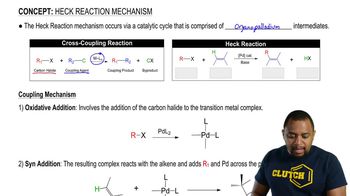
Heck Reaction Mechanism

Thermal Decomposition

Thermal decomposition refers to the process where a compound breaks down into simpler substances when heated. In the context of the reaction with heat, recognizing how heat influences the stability of reactants and products is vital. This concept is particularly relevant for understanding how certain functional groups may rearrange or eliminate under heat, leading to the formation of multiple products.
추천 영상:
06:36
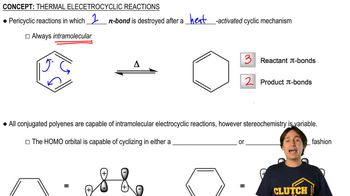
MO Theory of Thermal Electrocyclics
관련 실천