Ch. 7 - Structure and Synthesis of Alkenes; Elimination
Wade - Organic Chemistry 9th Edition
Wade9th EditionOrganic ChemistryISBN: 9780135213728당신이 사용하는 게 아니라요?교과서 변경
7장, 문제 39b

Propose mechanisms for the following reactions.
(b) Chemical reaction diagram showing dehydration of an alcohol to form alkenes and alkynes with sulfuric acid and heat.
HINT: Alcohol dehydrations usually go through E1 elimination of the protonated alcohol, with a carbocation intermediate. Rearrangements are common.

검증된 단계별 안내
1
Step 1: Protonation of the alcohol group: The reaction begins with the alcohol group (-OH) being protonated by the sulfuric acid (H₂SO₄). This forms a good leaving group (water) and converts the alcohol into a protonated alcohol intermediate.
Step 2: Formation of the carbocation: After protonation, the water molecule leaves, generating a carbocation intermediate. In this case, the carbocation is formed at the carbon attached to the original alcohol group.
Step 3: Carbocation rearrangement: Carbocations can undergo rearrangements to form more stable carbocations. In this reaction, the initial carbocation may rearrange to form a more stable secondary or tertiary carbocation, depending on the structure of the molecule.
Step 4: Elimination to form alkenes: The carbocation undergoes elimination (E1 mechanism) by losing a proton from an adjacent carbon atom. This results in the formation of double bonds (alkenes). Multiple products are possible due to the different positions where elimination can occur.
Step 5: Formation of cycloalkenes: In addition to linear alkenes, cycloalkenes can form as a result of ring closure or rearrangement during the elimination process. This explains the presence of the cyclic alkene product in the reaction.

비슷한 문제에 대한 검증된 영상 답변:

이 영상 해법은 위 문제에 도움이 된다고 튜터들이 추천한 것입니다.
영상 길이:
7m
도움이 되었나요?

주요 개념

질문에 올바르게 답하기 위해 반드시 이해해야 하는 핵심 개념들은 다음과 같습니다.

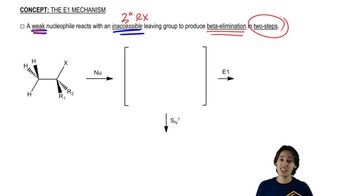
E1 Mechanism

The E1 mechanism is a type of elimination reaction that involves two steps: the formation of a carbocation intermediate followed by the loss of a proton to form a double bond. In the context of alcohol dehydration, the alcohol is first protonated, leading to the departure of water and the generation of a carbocation, which can then undergo elimination to form alkenes.
추천 영상:
08:09
Drawing the E1 Mechanism.

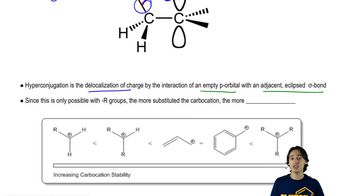
Carbocation Stability

Carbocation stability is crucial in determining the outcome of reactions involving carbocations. Tertiary carbocations are more stable than secondary or primary ones due to hyperconjugation and inductive effects. During the dehydration of alcohols, rearrangements may occur to form more stable carbocations, influencing the final products of the reaction.
추천 영상:
05:58
Determining Carbocation Stability

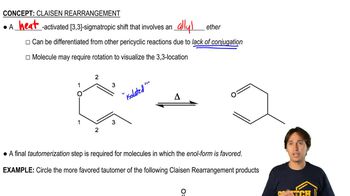
Rearrangements in Organic Reactions

Rearrangements refer to the structural changes that can occur during the formation of carbocations, often leading to more stable intermediates. In alcohol dehydration, a primary carbocation may rearrange to a more stable secondary or tertiary carbocation, which can significantly affect the products formed, including the types of alkenes generated.
추천 영상:
06:08
Definition of Claisen Rearrangement