Ch. 7 - Structure and Synthesis of Alkenes; Elimination
Wade - Organic Chemistry 9th Edition
Wade9th EditionOrganic ChemistryISBN: 9780135213728당신이 사용하는 게 아니라요?교과서 변경
7장, 문제 67b

Pure (S)-2-bromo-2-fluorobutane reacts with methoxide ion in methanol to give a mixture of (S)-2-fluoro-2-methoxybutane and three fluoroalkenes.
b. Propose a mechanism to show how (S)-2-bromo-2-fluorobutane reacts to give (S)-2-fluoro-2-methoxybutane. Has this reaction gone with retention or inversion of configuration?

검증된 단계별 안내
1
Step 1: Recognize the type of reaction. The reaction involves a substitution process where the bromine atom in (S)-2-bromo-2-fluorobutane is replaced by a methoxy group (-OCH3). This suggests a nucleophilic substitution mechanism, specifically an SN2 or SN1 pathway.
Step 2: Analyze the stereochemistry of the starting material. The starting compound, (S)-2-bromo-2-fluorobutane, has a chiral center at carbon-2. The configuration is (S), meaning the substituents are arranged in a specific spatial orientation.
Step 3: Propose the mechanism. In the presence of methoxide ion (CH3O⁻), the bromine atom (a good leaving group) is displaced. Since the product retains the (S) configuration, the reaction likely proceeds via an SN1 mechanism. In an SN1 reaction, the intermediate carbocation is planar, allowing the nucleophile to attack from either side. However, the fluorine atom exerts a strong inductive effect, stabilizing the carbocation and directing the attack preferentially to one side, leading to retention of configuration.
Step 4: Explain the retention of configuration. The retention occurs because the methoxide ion attacks the carbocation intermediate from the same side as the departing bromine atom. This is influenced by the stereoelectronic effects of the fluorine atom, which stabilizes the transition state and directs the nucleophile's approach.
Step 5: Conclude the stereochemical outcome. The reaction proceeds with retention of configuration, resulting in (S)-2-fluoro-2-methoxybutane as the product. This retention is consistent with the stereoelectronic effects of the fluorine atom and the nature of the SN1 mechanism.

비슷한 문제에 대한 검증된 영상 답변:

이 영상 해법은 위 문제에 도움이 된다고 튜터들이 추천한 것입니다.
영상 길이:
13m

주요 개념

질문에 올바르게 답하기 위해 반드시 이해해야 하는 핵심 개념들은 다음과 같습니다.

Nucleophilic Substitution Mechanism

Nucleophilic substitution is a fundamental reaction in organic chemistry where a nucleophile attacks an electrophile, resulting in the replacement of a leaving group. In this case, the methoxide ion acts as the nucleophile, attacking the carbon atom bonded to the bromine in (S)-2-bromo-2-fluorobutane. Understanding whether the reaction follows an SN1 or SN2 pathway is crucial for predicting the stereochemical outcome.
추천 영상:
01:47
Nucleophiles and Electrophiles can react in Substitution Reactions.

Stereochemistry and Configuration

Stereochemistry refers to the spatial arrangement of atoms in molecules and how this affects their chemical behavior. The configuration of a chiral center can be either retained or inverted during a reaction. In this scenario, determining whether the product (S)-2-fluoro-2-methoxybutane retains the original configuration or undergoes inversion is essential for understanding the stereochemical implications of the reaction.
추천 영상:
가이드 코스
1:38
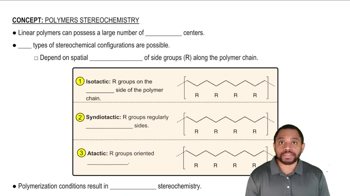
Polymer Stereochemistry Concept 1

Leaving Groups and Reactivity

The ability of a group to leave a molecule during a reaction is a key factor in determining the reaction's mechanism and rate. In this reaction, bromine is a good leaving group, facilitating the nucleophilic attack by the methoxide ion. The stability of the leaving group influences whether the reaction proceeds via an SN1 or SN2 mechanism, which in turn affects the stereochemical outcome of the product.
추천 영상:
07:22
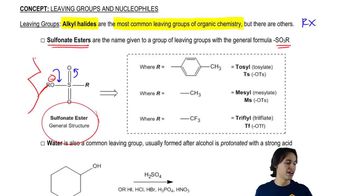
The 3 important leaving groups to know.
관련 실천
교과서 질문

When 2-bromo-3-phenylbutane is treated with sodium methoxide, two alkenes result (by E2 elimination). The Zaitsev product predominates.

a. Draw the reaction, showing the major and minor products.

1666
views

교과서 질문

a. Design an alkyl halide that will give only 2,4-diphenylpent-2-ene upon treatment with potassium tert-butoxide (a bulky base that promotes E2 elimination).

b. What stereochemistry is required in your alkyl halide so that only the following stereoisomer of the product is formed?

845
views
교과서 질문

When (±)−2,3−dibromobutane reacts with potassium hydroxide, some of the products are (2S,3R)-3-bromobutan-2-ol and its enantiomer and trans-2-bromobut-2-ene. Why is no cis-2-bromobut-2-ene formed?

972
views
교과서 질문

A chemist allows some pure (2S,3R)-3-bromo-2,3-diphenylpentane to react with a solution of sodium ethoxide (NaOCH2CH3) in ethanol. The products are two alkenes: A (cis-trans mixture) and B, a single pure isomer. Under the same conditions, the reaction of (2S,3S)-3-bromo-2,3-diphenylpentane gives two alkenes, A (cis-trans mixture) and C. Upon catalytic hydrogenation, all three of these alkenes (A, B, and C) give 2,3-diphenylpentane. Determine the structures of A, B, and C; give equations for their formation; and explain the stereospecificity of these reactions.

1654
views
교과서 질문

Pure (S)-2-bromo-2-fluorobutane reacts with methoxide ion in methanol to give a mixture of (S)-2-fluoro-2-methoxybutane and three fluoroalkenes.

a. Use mechanisms to show which three fluoroalkenes are formed.

2163
views
교과서 질문

When (±)−2,3−dibromobutane reacts with potassium hydroxide, some of the products are (2S,3R)-3-bromobutan-2-ol and its enantiomer and trans-2-bromobut-2-ene. Give mechanisms to account for these products.

1243
views