Ch. 7 - Structure and Synthesis of Alkenes; Elimination
Wade - Organic Chemistry 9th Edition
Wade9th EditionOrganic ChemistryISBN: 9780135213728당신이 사용하는 게 아니라요?교과서 변경
7장, 문제 17b

SN1 substitution and E1 elimination frequently compete in the same reaction.
b. Compare the function of the solvent (methanol) in the E1 and SN1 reactions.

검증된 단계별 안내
1
Understand the reaction types: Both SN1 (unimolecular nucleophilic substitution) and E1 (unimolecular elimination) reactions proceed through the formation of a carbocation intermediate. This intermediate is key to understanding the role of the solvent.
Recognize the role of methanol as a polar protic solvent: Methanol (CH₃OH) is a polar protic solvent, meaning it can stabilize charged species through hydrogen bonding. This stabilization is crucial for the formation of the carbocation intermediate in both SN1 and E1 reactions.
In the SN1 reaction, methanol acts as a nucleophile: After the carbocation is formed, methanol can attack the positively charged carbon atom, leading to the substitution product. Methanol's nucleophilicity is moderate, which makes it suitable for SN1 reactions.
In the E1 reaction, methanol facilitates proton removal: After the carbocation is formed, a base (often methanol itself or another molecule in the reaction mixture) can abstract a β-hydrogen from the carbocation, leading to the formation of a double bond (alkene) as the elimination product.
Compare the competition between SN1 and E1: The solvent (methanol) plays a dual role by stabilizing the carbocation intermediate and participating in the reaction. The product distribution (SN1 vs. E1) depends on factors such as the structure of the substrate (e.g., primary, secondary, or tertiary), reaction temperature, and the relative nucleophilicity and basicity of methanol.

비슷한 문제에 대한 검증된 영상 답변:

이 영상 해법은 위 문제에 도움이 된다고 튜터들이 추천한 것입니다.
영상 길이:
3m
도움이 되었나요?

주요 개념

질문에 올바르게 답하기 위해 반드시 이해해야 하는 핵심 개념들은 다음과 같습니다.

SN1 Mechanism

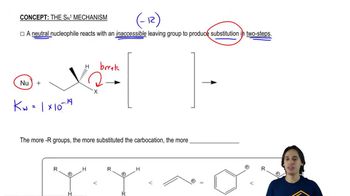
The SN1 (Substitution Nucleophilic Unimolecular) mechanism involves a two-step process where the first step is the formation of a carbocation intermediate after the leaving group departs. The nucleophile then attacks this carbocation in the second step. The rate of the reaction depends only on the concentration of the substrate, making it unimolecular. Solvent polarity can stabilize the carbocation, influencing the reaction rate.
추천 영상:
10:49
Drawing the SN1 Mechanism

E1 Mechanism

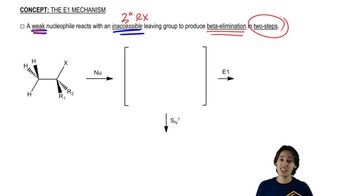
The E1 (Elimination Unimolecular) mechanism also proceeds through a two-step process, starting with the formation of a carbocation after the leaving group leaves. In the second step, a base abstracts a proton from a neighboring carbon, leading to the formation of a double bond. Similar to SN1, the rate of E1 depends solely on the substrate concentration, and the solvent can stabilize the carbocation, affecting the reaction pathway.
추천 영상:
08:09
Drawing the E1 Mechanism.

Role of Solvent

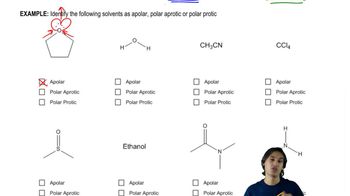
In both SN1 and E1 reactions, the solvent plays a crucial role in stabilizing the carbocation intermediate. Polar protic solvents, like methanol, can solvate the carbocation and the leaving group, facilitating their formation and enhancing reaction rates. The solvent's ability to stabilize charged species influences whether the reaction favors substitution or elimination, as the stability of the carbocation can determine the pathway taken.
추천 영상:
01:16
Identification of polarity in solvents
관련 실천