Ch. 7 - Structure and Synthesis of Alkenes; Elimination
Wade - Organic Chemistry 9th Edition
Wade9th EditionOrganic ChemistryISBN: 9780135213728당신이 사용하는 게 아니라요?교과서 변경
7장, 문제 10a

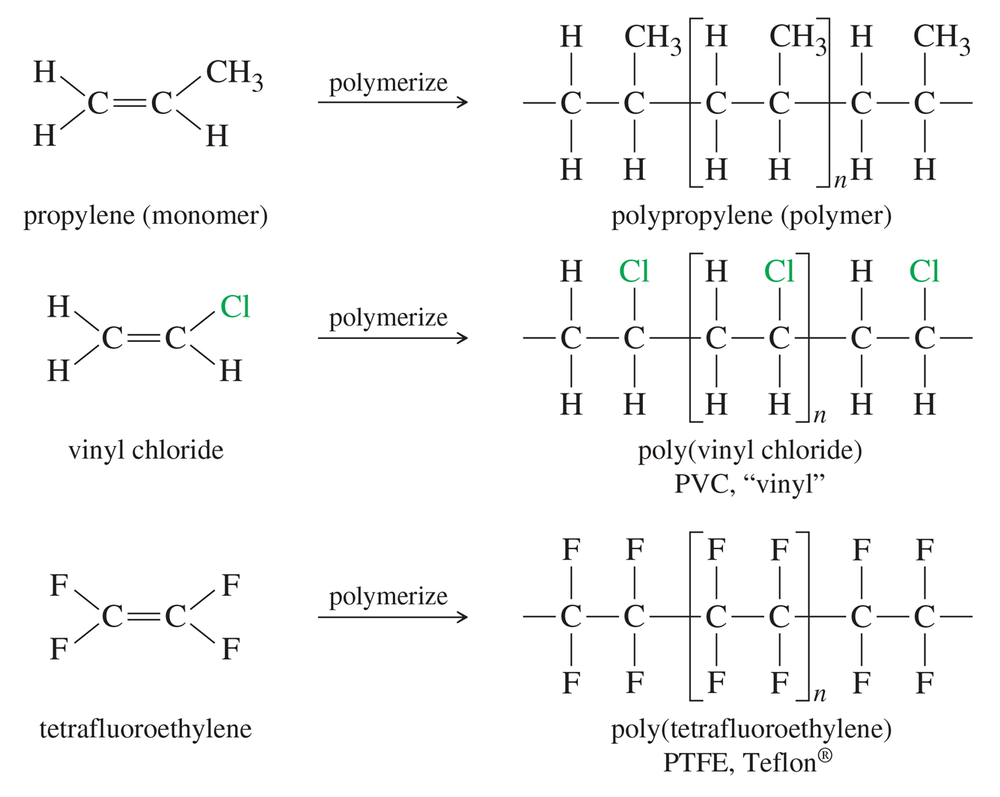
Teflon-coated frying pans routinely endure temperatures that would cause polyethylene or polypropylene to oxidize and decompose. Decomposition of polyethylene is initiated by free-radical abstraction of a hydrogen atom by O2. Bond-dissociation energies of C—H bonds are about 400 kJ/mol, and C—F bonds are about 460 kJ/mol. The BDE of the H—OO bond is about 192 kJ/mol, and the F—OO bond is about 63 kJ/mol. Show why Teflon (Figure 7-5) is much more resistant to oxidation than polyethylene is.

검증된 단계별 안내
1
Step 1: Analyze the bond-dissociation energies (BDEs) provided in the problem. The C—H bond in polyethylene has a BDE of approximately 400 kJ/mol, while the C—F bond in Teflon has a higher BDE of about 460 kJ/mol. This indicates that the C—F bond is stronger and less likely to undergo free-radical abstraction compared to the C—H bond.
Step 2: Compare the stability of the radicals formed during oxidation. When a hydrogen atom is abstracted from polyethylene, a carbon-centered radical is formed, which is relatively reactive. In contrast, the fluorine atoms in Teflon do not easily form radicals due to the high electronegativity and strong C—F bonds.
Step 3: Examine the bond-dissociation energies of the H—OO and F—OO bonds. The H—OO bond has a BDE of 192 kJ/mol, making it relatively weak and prone to decomposition. The F—OO bond, however, has a much lower BDE of 63 kJ/mol, but the formation of such bonds is unlikely due to the inert nature of fluorine in Teflon.
Step 4: Consider the chemical structure of Teflon (poly(tetrafluoroethylene)). The presence of fluorine atoms in Teflon creates a highly stable polymer due to the strong C—F bonds and the shielding effect of fluorine atoms, which prevent oxidative attack by O2 or other radicals.
Step 5: Conclude that Teflon is much more resistant to oxidation than polyethylene because its chemical structure and bond strengths make it less susceptible to free-radical reactions and decomposition under high temperatures.

비슷한 문제에 대한 검증된 영상 답변:

이 영상 해법은 위 문제에 도움이 된다고 튜터들이 추천한 것입니다.
영상 길이:
7m
도움이 되었나요?

주요 개념

질문에 올바르게 답하기 위해 반드시 이해해야 하는 핵심 개념들은 다음과 같습니다.

Bond Dissociation Energy (BDE)

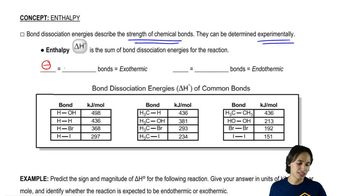
Bond dissociation energy is the energy required to break a specific bond in a molecule, measured in kJ/mol. In the context of Teflon and polyethylene, the BDE of C—F bonds in Teflon (460 kJ/mol) is significantly higher than that of C—H bonds in polyethylene (400 kJ/mol). This higher energy requirement makes Teflon more resistant to oxidative degradation, as it is less likely for the C—F bonds to break under oxidative conditions.
추천 영상:
가이드 코스
04:09
How to calculate enthalpy using bond dissociation energies.

Free Radical Mechanism

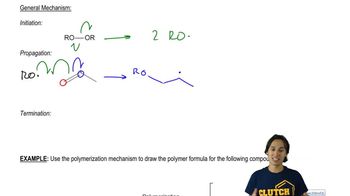
The free radical mechanism involves the formation of highly reactive species with unpaired electrons, which can initiate chain reactions leading to polymer degradation. In polyethylene, free radicals can abstract hydrogen atoms from C—H bonds, leading to chain scission and oxidation. Teflon's structure, with C—F bonds, is less susceptible to such radical attacks, making it more stable under oxidative conditions.
추천 영상:
가이드 코스
03:28
The mechanism of Radical Polymerization.

Polymer Structure and Stability

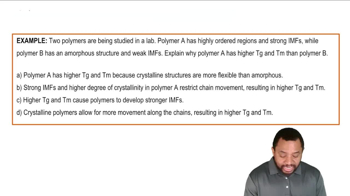
The structure of a polymer significantly influences its chemical stability and resistance to degradation. Teflon (PTFE) has a highly stable structure due to the presence of fluorine atoms, which create strong C—F bonds and a protective layer around the carbon backbone. In contrast, polyethylene lacks such stabilizing features, making it more prone to oxidation and decomposition at elevated temperatures.
추천 영상:
1:31
Polymers Structure and Properties Example 3