Ch. 7 - Structure and Synthesis of Alkenes; Elimination
Wade - Organic Chemistry 9th Edition
Wade9th EditionOrganic ChemistryISBN: 9780135213728당신이 사용하는 게 아니라요?교과서 변경
7장, 문제 13

Using Table 7-2 as a guide, predict which member of each pair is more stable, as well as by about how many kJ/mol or kcal/mol.
a. cis,cis-hexa-2,4-diene or trans,trans-hexa-2,4-diene
b. 2-methylbut-1-ene or 3-methylbut-1-ene
c. 2-methylbut-1-ene or 2-methylbut-2-ene
d. cis-4-methylpent-2-ene or 2-methylpent-2-ene

검증된 단계별 안내
1
Step 1: Understand the relationship between the molar heat of hydrogenation and stability. A lower molar heat of hydrogenation corresponds to greater stability of the alkene. This is because less energy is released when hydrogenating a more stable alkene.
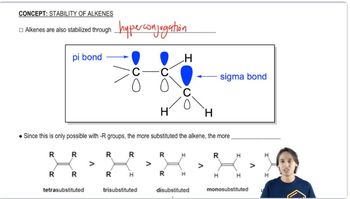
Step 2: Compare the substitution patterns of the alkenes in each pair. Alkenes with more substituents on the double bond are generally more stable due to hyperconjugation and inductive effects. Use the provided tables to identify the substitution pattern (e.g., monosubstituted, disubstituted, trisubstituted, or tetrasubstituted).
Step 3: For part (a), compare cis,cis-hexa-2,4-diene and trans,trans-hexa-2,4-diene. The trans configuration is generally more stable than the cis configuration due to reduced steric hindrance between substituents. Use the molar heat of hydrogenation values for cis-disubstituted and trans-disubstituted alkenes to estimate the difference in stability.
Step 4: For part (b), compare 2-methylbut-1-ene and 3-methylbut-1-ene. Both are monosubstituted alkenes, but the position of the methyl group affects steric interactions. Refer to the table to determine the molar heat of hydrogenation for each structure and predict the more stable alkene.
Step 5: For parts (c) and (d), compare the substitution patterns of the alkenes. In part (c), 2-methylbut-1-ene is monosubstituted, while 2-methylbut-2-ene is trisubstituted, making the latter more stable. In part (d), cis-4-methylpent-2-ene is cis-disubstituted, while 2-methylpent-2-ene is trisubstituted, indicating that 2-methylpent-2-ene is more stable. Use the molar heat of hydrogenation values to estimate the differences in stability.

비슷한 문제에 대한 검증된 영상 답변:

이 영상 해법은 위 문제에 도움이 된다고 튜터들이 추천한 것입니다.
영상 길이:
10m
도움이 되었나요?

주요 개념

질문에 올바르게 답하기 위해 반드시 이해해야 하는 핵심 개념들은 다음과 같습니다.

Stability of Alkenes

The stability of alkenes is influenced by their degree of substitution and stereochemistry. More substituted alkenes are generally more stable due to hyperconjugation and the inductive effect, which distribute electron density more effectively. Additionally, trans isomers are typically more stable than cis isomers because of reduced steric strain between substituents.
추천 영상:
04:28
Understanding trends of alkene stability.

Stereochemistry

Stereochemistry refers to the spatial arrangement of atoms in molecules and how this affects their chemical properties. In alkenes, the configuration (cis or trans) can significantly impact stability due to steric interactions. Understanding stereochemistry is crucial for predicting the relative stability of different isomers.
추천 영상:
가이드 코스
1:38
Polymer Stereochemistry Concept 1

Thermodynamic Stability and Energy Differences

Thermodynamic stability is often quantified in terms of energy differences between isomers, typically measured in kJ/mol or kcal/mol. A more stable compound has a lower energy state, and the energy difference can be used to predict the favorability of one isomer over another. This concept is essential for making predictions about the stability of the alkenes in the given pairs.
추천 영상:
03:43
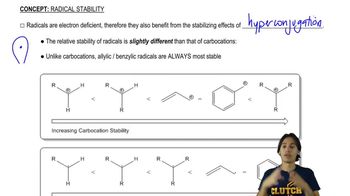
The radical stability trend.