The following reaction is called the pinacol rearrangement. The reaction begins with an acid-promoted ionization to give a carbocation. This carbocation undergoes a methyl shift to give a more stable, resonance-stabilized cation. Loss of a proton gives the observed product. Propose a mechanism for the pinacol rearrangement.
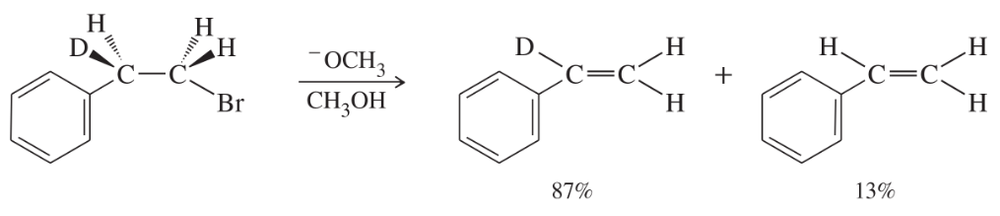
When the following compound is treated with sodium methoxide in methanol, two elimination products are possible. Explain why the deuterated product predominates by about a 7:1 ratio (refer to Problem 7-75).

검증된 단계별 안내
비슷한 문제에 대한 검증된 영상 답변:
주요 개념
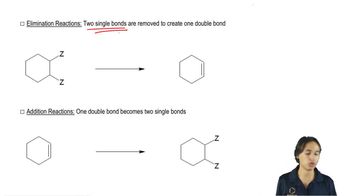
Elimination Reactions
Regioselectivity
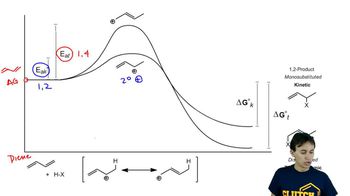
Kinetic vs. Thermodynamic Control
Deuterium (D) is the isotope of hydrogen of mass number 2, with a proton and a neutron in its nucleus. The chemistry of deuterium is nearly identical to the chemistry of hydrogen, except that the C―D bond is slightly (5.0 kJ/mol, or 1.2 kcal/mol) stronger than the C―H bond. Reaction rates tend to be slower if a C―D bond (as opposed to a C―H bond) is broken in a rate-limiting step. This effect on the rate is called a kinetic isotope effect. (Review Problem 4-57)
b. When the following deuterated compound reacts under the same conditions, the rate of formation of the substitution product is unchanged, while the rate of formation of the elimination product is slowed by a factor of 7.
Explain why the elimination rate is slower, but the substitution rate is unchanged.

Deuterium (D) is the isotope of hydrogen of mass number 2, with a proton and a neutron in its nucleus. The chemistry of deuterium is nearly identical to the chemistry of hydrogen, except that the C―D bond is slightly (5.0 kJ/mol, or 1.2 kcal/mol) stronger than the C―H bond. Reaction rates tend to be slower if a C―D bond (as opposed to a C―H bond) is broken in a rate-limiting step. This effect on the rate is called a kinetic isotope effect. (Review PROBLEM 4-57)
a. Propose a mechanism to explain each product in the following reaction.