뒤로
뒤로
문제 30b
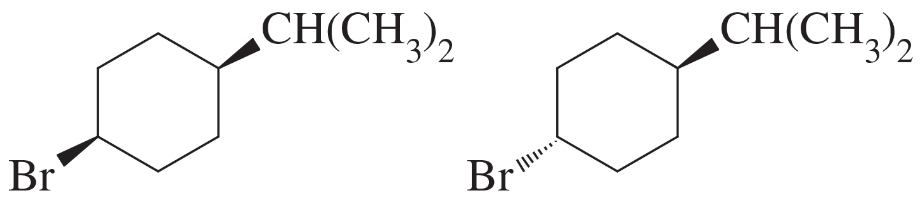
Predict which of the following compounds will undergo elimination with KOH faster, and explain why. Predict the major product that will be formed.
문제 31a
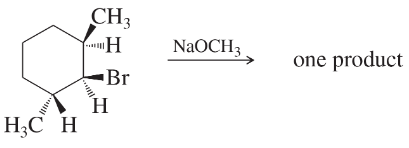
Give the expected product(s) of E2 elimination for each reaction. (Hint: Use models!)
(a)
문제 31b
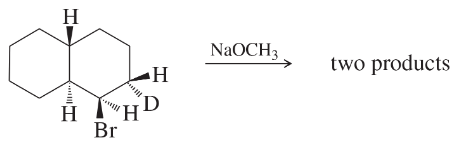
Give the expected product(s) of E2 elimination for each reaction. (Hint: Use models!)
(b)
문제 32a
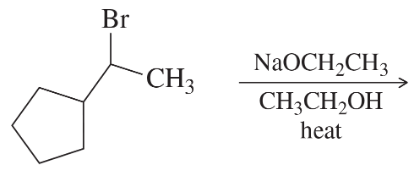
Predict the major and minor elimination products of the following proposed reactions (ignoring any possible substitutions for now). In each case, explain whether you expect the mechanism of the elimination to be E1 or E2.
(a)
문제 32b
Predict the major and minor elimination products of the following proposed reactions (ignoring any possible substitutions for now). In each case, explain whether you expect the mechanism of the elimination to be E1 or E2.
(b)
문제 33a
Predict the products and mechanisms of the following reactions. When more than one product or mechanism is possible, explain which are most likely.
a. 1−bromohexane + sodium ethoxide in ethanol
문제 33b
Predict the products and mechanisms of the following reactions. When more than one product or mechanism is possible, explain which are most likely.
b. 2−chlorohexane + NaOCH3 in methanol
문제 33e,f
Predict the products and mechanisms of the following reactions. When more than one product or mechanism is possible, explain which are most likely.
e. isobutyliodide + KOH in ethanol/water
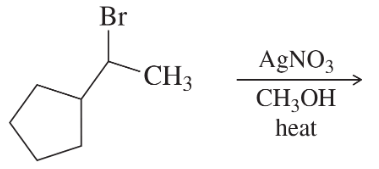
f. isobutylchloride + AgNO3 in ethanol/water
문제 33g
Predict the products and mechanisms of the following reactions. When more than one product or mechanism is possible, explain which are most likely.
g. 1−bromo−1−methylcyclopentane + NaOEt in ethanol
문제 33h
Predict the products and mechanisms of the following reactions. When more than one product or mechanism is possible, explain which are most likely.
h. 1-bromo-1-methylcyclopentane heated in methanol
문제 34a
Propose mechanisms for the following reactions.
(a)
문제 34b
Propose mechanisms for the following reactions.
(b)
문제 34c
Propose mechanisms for the following reactions.
(c)
문제 34d
Propose mechanisms for the following reactions.
(d)
문제 35a
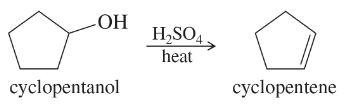
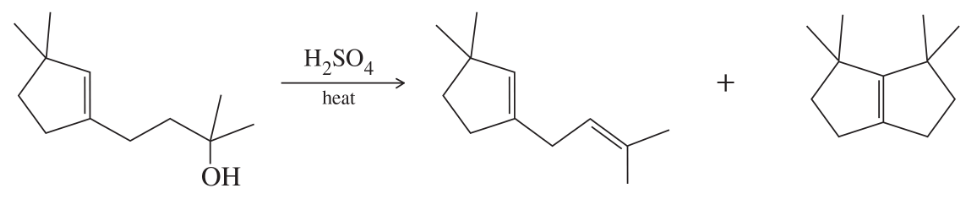
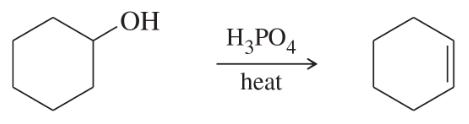
Show the product(s) you expect from dehydration of the following alcohols when they are heated in sulfuric or phosphoric acid. In each case, use a mechanism to show how the products are formed.
(a)
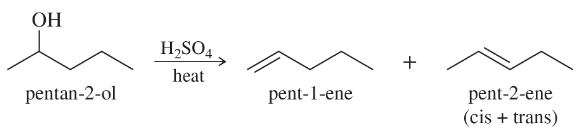
문제 35b
Show the product(s) you expect from dehydration of the following alcohols when they are heated in sulfuric or phosphoric acid. In each case, use a mechanism to show how the products are formed.
(b)
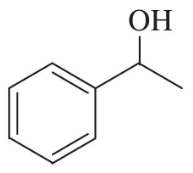
문제 35c
Show the product(s) you expect from dehydration of the following alcohols when they are heated in sulfuric or phosphoric acid. In each case, use a mechanism to show how the products are formed.
(c)
문제 36a
The dehydrogenation of butane to trans-but-2-ene has ΔH° = +116 kJ/mol (+27.6 kcal/mol) and ΔS° = +117J/kelvin-mol (+28.0 cal/kelvin-mol).
a. Compute the value of ΔG° for dehydrogenation at room temperature (25 °C or 298 °K). Is dehydrogenation favored or disfavored?
HINT: When you are doing synthesis problems, avoid using these high-temperature industrial methods. They require specialized equipment, and they produce variable mixtures of products.
문제 37a
For practice in recognizing mechanisms, classify each reaction according to the type of mechanism you expect:
1. Free-radical chain reaction
2. Reaction involving strong bases and strong nucleophiles
3. Reaction involving strong acids and strong electrophiles
(a)
문제 37b
For practice in recognizing mechanisms, classify each reaction according to the type of mechanism you expect:
1. Free-radical chain reaction
2. Reaction involving strong bases and strong nucleophiles
3. Reaction involving strong acids and strong electrophiles
(b)
문제 37c
For practice in recognizing mechanisms, classify each reaction according to the type of mechanism you expect:
1. Free-radical chain reaction
2. Reaction involving strong bases and strong nucleophiles
3. Reaction involving strong acids and strong electrophiles
(c)
문제 37d
For practice in recognizing mechanisms, classify each reaction according to the type of mechanism you expect:
1. Free-radical chain reaction
2. Reaction involving strong bases and strong nucleophiles
3. Reaction involving strong acids and strong electrophiles.
(d)
문제 38a
Propose mechanisms for the following reactions. Additional products may be formed, but your mechanism only needs to explain the products shown.
(a)
(Hint: Hydride shift)
문제 38c
Propose mechanisms for the following reactions. Additional products may be formed, but your mechanism only needs to explain the products shown.
(c)
문제 39a
Propose mechanisms for the following reactions.
(a)
HINT: Alcohol dehydrations usually go through E1 elimination of the protonated alcohol, with a carbocation intermediate. Rearrangements are common.
문제 39b
Propose mechanisms for the following reactions.
(b)
HINT: Alcohol dehydrations usually go through E1 elimination of the protonated alcohol, with a carbocation intermediate. Rearrangements are common.
문제 39d
Propose mechanisms for the following reactions.
d.
HINT: Alcohol dehydrations usually go through E1 elimination of the protonated alcohol, with a carbocation intermediate. Rearrangements are common.
문제 40a,b,c
Draw a structure for each compound (includes old and new names).
a. 3-methylpent-1-ene
b. cis-3-methyl-3-hexene
c. 3,4-dibromobut-1-ene
문제 40d,e,f
Draw a structure for each compound (includes old and new names).
d. 1,3-cyclohexadiene
e. cycloocta-1,4-diene
f. (Z)-3-methyl-2-octene
문제 40g,h
Draw a structure for each compound (includes old and new names).
g. vinylcyclopropane
h. (Z)-2-bromo-2-pentene