Ch.8 - Reactions of Alkenes
Wade - Organic Chemistry 9th Edition
Wade9th EditionOrganic ChemistryISBN: 9780135213728당신이 사용하는 게 아니라요?교과서 변경
8장, 문제 31

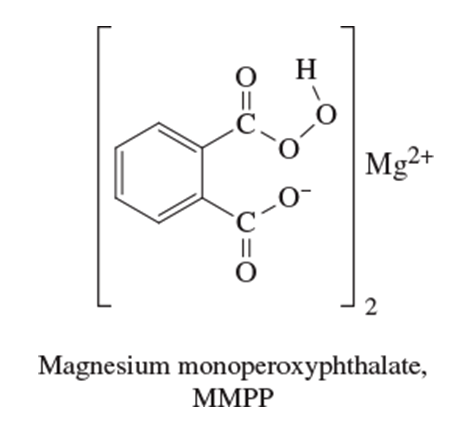
Magnesium monoperoxyphthalate (MMPP) epoxidizes alkenes much like mCPBA. MMPP is more stable, however, and it may be safer to use for large-scale and industrial reactions. Propose a mechanism for the reaction of trans-2-methylhept-3-ene with MMPP, and predict the structure of the product(s).

검증된 단계별 안내
1
Step 1: Recognize that MMPP is a peracid, similar to mCPBA, and is used to epoxidize alkenes. The reaction involves the transfer of an oxygen atom from the peracid to the alkene, forming an epoxide.
Step 2: Analyze the structure of trans-2-methylhept-3-ene. It is an alkene with a double bond between carbons 3 and 4, and a methyl group attached to carbon 2. The trans configuration indicates that the substituents on the double bond are on opposite sides.
Step 3: Propose the mechanism for the reaction. The alkene undergoes electrophilic attack by the peracid (MMPP). The oxygen atom from the peracid is transferred to the double bond, forming a three-membered epoxide ring. This occurs via a concerted mechanism where the π-electrons of the alkene attack the electrophilic oxygen, and the peracid donates the oxygen atom.
Step 4: Predict the stereochemistry of the product. Since the starting alkene is trans, the epoxide ring will retain the stereochemical information. The substituents on the epoxide will be on opposite sides of the ring, consistent with the trans configuration.
Step 5: Draw the product structure. The product will be a trans-epoxide derived from trans-2-methylhept-3-ene. The methyl group on carbon 2 and the rest of the chain will remain unchanged, while the double bond is replaced by an epoxide ring.

비슷한 문제에 대한 검증된 영상 답변:

이 영상 해법은 위 문제에 도움이 된다고 튜터들이 추천한 것입니다.
영상 길이:
6m
도움이 되었나요?

주요 개념

질문에 올바르게 답하기 위해 반드시 이해해야 하는 핵심 개념들은 다음과 같습니다.

Epoxidation

Epoxidation is a chemical reaction that involves the conversion of alkenes into epoxides, which are three-membered cyclic ethers. This reaction typically occurs through the addition of an electrophilic oxygen species to the double bond of the alkene. In this case, magnesium monoperoxyphthalate (MMPP) acts as the oxidizing agent, facilitating the formation of the epoxide from trans-2-methylhept-3-ene.
추천 영상:
02:19
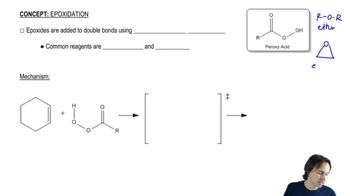
General properties of epoxidation.

Mechanism of Epoxidation

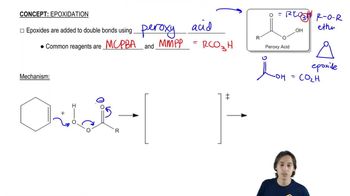
The mechanism of epoxidation generally involves the formation of a cyclic transition state where the alkene double bond attacks the electrophilic oxygen of the oxidizing agent. This results in the formation of a three-membered epoxide ring. Understanding this mechanism is crucial for predicting the stereochemistry and regioselectivity of the product formed from the reaction of trans-2-methylhept-3-ene with MMPP.
추천 영상:
03:19
The mechanism of how peroxy acids make epoxides.

Stability of MMPP

Magnesium monoperoxyphthalate (MMPP) is noted for its stability compared to other peracids like mCPBA. This stability makes MMPP a safer choice for large-scale industrial applications. Its structure, which includes a magnesium ion and peroxy groups, contributes to its reactivity while minimizing the risks associated with handling more reactive peracids, thus making it a preferred reagent in organic synthesis.
추천 영상:
03:43
The radical stability trend.