Ch.8 - Reactions of Alkenes
Wade - Organic Chemistry 9th Edition
Wade9th EditionOrganic ChemistryISBN: 9780135213728당신이 사용하는 게 아니라요?교과서 변경
8장, 문제 56a

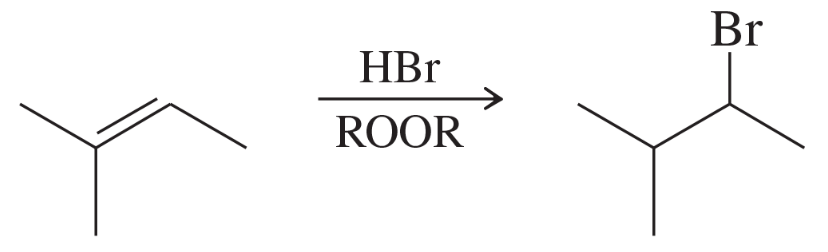
Propose mechanisms consistent with the following reactions.
(a)

검증된 단계별 안내
1
Step 1: Recognize that the reaction involves the addition of HBr in the presence of a peroxide (ROOR or H2O2). This is a classic example of anti-Markovnikov addition due to the radical mechanism induced by the peroxide.
Step 2: Initiation: The peroxide (ROOR or H2O2) undergoes homolytic cleavage under heat or light to form two alkoxy radicals. This step generates the reactive species needed to start the radical chain reaction.
Step 3: Propagation: The alkoxy radical reacts with HBr, abstracting a hydrogen atom to form a bromine radical (Br•). The bromine radical then reacts with the alkene, adding to the less substituted carbon of the double bond to form a new carbon-centered radical.
Step 4: The newly formed carbon-centered radical reacts with another molecule of HBr, abstracting a hydrogen atom to form the final product, where bromine is attached to the less substituted carbon of the original double bond.
Step 5: Termination: Any two radicals in the system can combine to form a stable molecule, ending the chain reaction. This step ensures that the reaction does not continue indefinitely.

비슷한 문제에 대한 검증된 영상 답변:

이 영상 해법은 위 문제에 도움이 된다고 튜터들이 추천한 것입니다.
영상 길이:
7m
도움이 되었나요?

주요 개념

질문에 올바르게 답하기 위해 반드시 이해해야 하는 핵심 개념들은 다음과 같습니다.

Electrophilic Addition Reactions

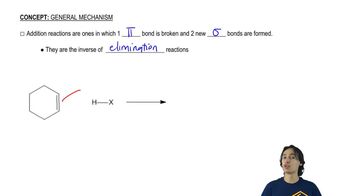
Electrophilic addition reactions involve the addition of an electrophile to a nucleophile, typically across a double or triple bond. In this case, HBr acts as the electrophile, adding to the alkene. Understanding the mechanism of electrophilic addition is crucial for predicting the products formed in reactions involving alkenes and alkynes.
추천 영상:
05:39
Features of Addition Mechanisms.

Radical Mechanisms

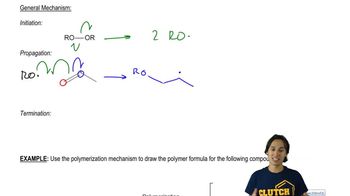
Radical mechanisms involve the formation and reaction of free radicals, which are highly reactive species with unpaired electrons. The presence of ROOR (peroxides) suggests a radical pathway, where the addition of HBr can proceed via a radical mechanism, leading to the formation of brominated products. Recognizing the role of radicals is essential for understanding the reaction pathway.
추천 영상:
03:28
The mechanism of Radical Polymerization.

Markovnikov's Rule

Markovnikov's Rule states that in the addition of HX to an alkene, the hydrogen atom will attach to the carbon with the greater number of hydrogen atoms already attached, while the halide will attach to the carbon with fewer hydrogen atoms. This principle helps predict the regioselectivity of the product formed in the reaction, which is important for proposing accurate mechanisms.
추천 영상:
03:54
The 18 and 16 Electron Rule