Ch.8 - Reactions of Alkenes
Wade - Organic Chemistry 9th Edition
Wade9th EditionOrganic ChemistryISBN: 9780135213728당신이 사용하는 게 아니라요?교과서 변경
8장, 문제 45c

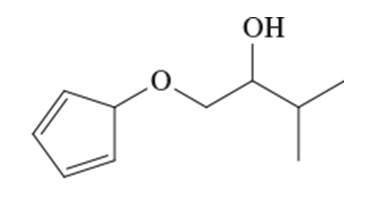
Show how you would synthesize each compound, starting with alkenes or cycloalkenes that contain no more than six carbon atoms. You may use any additional reagents you need.
(c)

검증된 단계별 안내
1
Step 1: Begin with cyclopentene as the starting alkene. Cyclopentene is a five-membered ring with one double bond, which satisfies the requirement of having no more than six carbon atoms.
Step 2: Perform an epoxidation reaction on cyclopentene using a peracid, such as mCPBA (meta-chloroperoxybenzoic acid). This will convert the double bond into an epoxide, forming oxirane (a three-membered cyclic ether) on the cyclopentane ring.
Step 3: Open the epoxide ring using an alcohol nucleophile, such as ethanol, in the presence of an acid catalyst (e.g., H+). This will result in the addition of the ethanol group to one of the carbons of the epoxide, forming an ether bond.
Step 4: Oxidize the terminal carbon of the ethanol group to form a hydroxyl group (-OH). This can be achieved using mild oxidizing agents such as PCC (pyridinium chlorochromate) or Jones reagent.
Step 5: Verify the structure of the final product, ensuring that the cyclopentane ring contains an ether linkage and the ethanol group is oxidized to include the hydroxyl group (-OH) at the terminal position.

비슷한 문제에 대한 검증된 영상 답변:

이 영상 해법은 위 문제에 도움이 된다고 튜터들이 추천한 것입니다.
영상 길이:
15m

주요 개념

질문에 올바르게 답하기 위해 반드시 이해해야 하는 핵심 개념들은 다음과 같습니다.

Alkenes and Cycloalkenes

Alkenes are hydrocarbons that contain at least one carbon-carbon double bond, while cycloalkenes are cyclic compounds with one or more double bonds. These compounds are fundamental in organic synthesis due to their reactivity, allowing for various reactions such as addition, polymerization, and oxidation. Understanding their structure and reactivity is crucial for designing synthetic pathways.
추천 영상:
01:11
How to find the root name for cycloalkanes

Retrosynthetic Analysis

Retrosynthetic analysis is a strategy used in organic chemistry to deconstruct a target molecule into simpler precursor structures. This method involves identifying functional groups and potential reaction pathways that could lead to the desired compound. It is essential for planning syntheses, as it helps chemists visualize the steps needed to create complex molecules from simpler ones.
추천 영상:
01:22
Retrosynthesis

Functional Group Transformations

Functional group transformations involve converting one functional group into another through chemical reactions. This concept is vital in organic synthesis, as it allows chemists to modify molecules to achieve desired properties or reactivity. Common transformations include oxidation, reduction, and substitution reactions, which are often employed in the synthesis of complex organic compounds.
추천 영상:
02:36
Identifying Functional Groups