Ch.8 - Reactions of Alkenes
Wade - Organic Chemistry 9th Edition
Wade9th EditionOrganic ChemistryISBN: 9780135213728당신이 사용하는 게 아니라요?교과서 변경
8장, 문제 74

The cationic polymerization of isobutylene (2-methylpropene) is shown in Section 8-16A. Isobutylene is often polymerized under free-radical conditions. Propose a mechanism for the free-radical polymerization of isobutylene.

검증된 단계별 안내
1
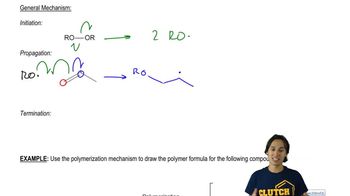
Identify the three main stages of free-radical polymerization: initiation, propagation, and termination. These stages will guide the mechanism for the polymerization of isobutylene.
In the initiation step, a free radical is generated. This is typically achieved by using an initiator such as benzoyl peroxide or AIBN (azobisisobutyronitrile). The initiator decomposes under heat or UV light to form free radicals. Write the decomposition reaction of the initiator to show the formation of free radicals.
In the propagation step, the free radical generated in the initiation step reacts with the double bond of isobutylene (2-methylpropene). This reaction forms a new carbon-centered radical at the terminal carbon of the isobutylene molecule. Represent this step using a curved arrow mechanism to show the movement of electrons from the radical to the double bond and the formation of the new radical.
Continue the propagation step by showing how the newly formed radical reacts with another molecule of isobutylene. This step repeats, leading to the growth of the polymer chain. Use a general structure to represent the growing polymer chain and show the addition of another isobutylene unit.
In the termination step, two growing polymer radicals combine to form a stable, non-radical product. This can occur through coupling (where two radicals directly combine) or disproportionation (where one radical abstracts a hydrogen atom from another radical). Write the possible termination reactions and explain how they lead to the end of the polymerization process.

비슷한 문제에 대한 검증된 영상 답변:

이 영상 해법은 위 문제에 도움이 된다고 튜터들이 추천한 것입니다.
영상 길이:
7m

주요 개념

질문에 올바르게 답하기 위해 반드시 이해해야 하는 핵심 개념들은 다음과 같습니다.

Free-Radical Polymerization

Free-radical polymerization is a method of polymer synthesis that involves the formation of free radicals, which are highly reactive species with unpaired electrons. This process typically occurs in three main steps: initiation, propagation, and termination. In the initiation step, a radical initiator generates free radicals that react with monomers, leading to the growth of polymer chains through repeated addition of monomer units.
추천 영상:
03:28
The mechanism of Radical Polymerization.

Cationic Polymerization

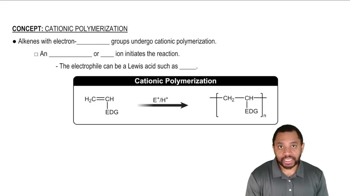
Cationic polymerization is a type of chain-growth polymerization that involves the formation of a positively charged cation as an active center. This mechanism is characterized by the addition of monomers that can stabilize a positive charge, allowing for the growth of the polymer chain. While the question focuses on free-radical conditions, understanding cationic polymerization provides insight into alternative mechanisms and the behavior of isobutylene under different conditions.
추천 영상:
가이드 코스
0:57
Cationic Polymerization Concept 1

Isobutylene Structure and Reactivity

Isobutylene, or 2-methylpropene, is an alkene with a branched structure that influences its reactivity in polymerization processes. The presence of the double bond makes it susceptible to addition reactions, which are fundamental in polymerization. Understanding the structure of isobutylene helps predict how it will behave under free-radical conditions, including the formation of stable radical intermediates during the polymerization process.
추천 영상:
01:17
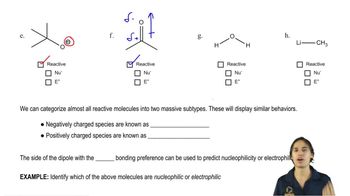
Reactivity of Molecules
관련 실천
교과서 질문

Propose a mechanism for reaction of the first three propylene units in the polymerization of propylene in the presence of a peroxide.

1694
views

교과서 질문

Ozonolysis can be applied selectively to different types of carbon–carbon double bonds. The compound shown below contains two vinyl ether double bonds, which are electron-rich because of the electron-donating alkoxy groups. Ozone reacts more quickly with electron-rich double bonds and more slowly with hindered double bonds. At −78 °C, this compound quickly adds two equivalents of ozone. Immediate reduction of the ozonide gives a good yield of a single product. Show the expected ozonolyis product, and label the functional groups produced, some of which are not typical from ozonolysis of simple alkenes.

1014
views
교과서 질문

When styrene (vinylbenzene) is commercially polymerized, about 1–3% of 1,4-divinylbenzene is often added to the styrene. The incorporation of some divinylbenzene gives a polymer with more strength and better resistance to organic solvents. Explain how a very small amount of divinylbenzene has a marked effect on the properties of the polymer.

1427
views
교과서 질문

An inexperienced graduate student treated dec-5-ene with borane in THF, placed the flask in a refrigerator, and left for a party. When he returned from the party, he discovered that the refrigerator was broken and that it had gotten quite warm inside. Although all the THF had evaporated from the flask, he treated the residue with basic hydrogen peroxide. To his surprise, he recovered a fair yield of decan-1-ol. Use a mechanism to show how this reaction might have occurred. (Hint: The addition of BH3 is reversible.)

1066
views
교과서 질문

A graduate student attempted to form the iodohydrin of the alkene shown below. Her analysis of the products showed a good yield of an unexpected product. Propose a mechanism to explain the formation of this product.

1003
views
교과서 질문

Propose mechanisms to explain the opposite regiochemistry observed in the following two reactions.

907
views