Ch.9 - Alkynes
Wade - Organic Chemistry 9th Edition
Wade9th EditionOrganic ChemistryISBN: 9780135213728당신이 사용하는 게 아니라요?교과서 변경
9장, 문제 34i

Show how you would accomplish the following synthetic transformations. Show all intermediates.
i. hex-1-yne → hexanal, CH3(CH2)4CHO

검증된 단계별 안내
1
Step 1: Analyze the transformation. The starting material is hex-1-yne, an alkyne, and the product is hexanal, an aldehyde. This indicates that the triple bond in hex-1-yne must be converted into a single bond, and the terminal carbon must be oxidized to form the aldehyde functional group.
Step 2: Select the appropriate reaction. To convert a terminal alkyne into an aldehyde, hydroboration-oxidation is a suitable method. This involves two steps: (a) hydroboration using a reagent like disiamylborane (R2BH) or 9-BBN, and (b) oxidation using hydrogen peroxide (H2O2) in a basic solution (NaOH).
Step 3: Perform hydroboration. Add disiamylborane (R2BH) to hex-1-yne. The boron atom selectively adds to the less substituted carbon of the triple bond, forming an organoborane intermediate.
Step 4: Oxidize the organoborane intermediate. Treat the organoborane with hydrogen peroxide (H2O2) in the presence of a base (NaOH). This step converts the boron-attached carbon into an aldehyde group, yielding hexanal.
Step 5: Verify the product. The final product is hexanal, CH3(CH2)4CHO, which matches the desired transformation. Ensure all intermediates and reagents are accounted for in the mechanism.

비슷한 문제에 대한 검증된 영상 답변:

이 영상 해법은 위 문제에 도움이 된다고 튜터들이 추천한 것입니다.
영상 길이:
7m

주요 개념

질문에 올바르게 답하기 위해 반드시 이해해야 하는 핵심 개념들은 다음과 같습니다.

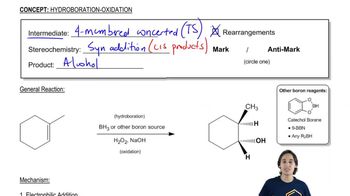
Alkyne Hydroboration-Oxidation

This reaction involves the addition of borane (BH3) to an alkyne, followed by oxidation with hydrogen peroxide (H2O2) in the presence of a base. For hex-1-yne, this process converts the terminal alkyne into an aldehyde, specifically hexanal, by forming a trialkyl borane intermediate that is subsequently oxidized.
추천 영상:
06:38
General properties of hydroboration-oxidation.

Markovnikov's Rule

Markovnikov's Rule states that in the addition of HX to an alkene or alkyne, the hydrogen atom will attach to the carbon with the greater number of hydrogen atoms already attached. This principle is crucial in predicting the formation of intermediates during the hydroboration of hex-1-yne, leading to the correct regioselectivity in the final product, hexanal.
추천 영상:
03:54
The 18 and 16 Electron Rule

Synthetic Pathways and Intermediates

Understanding synthetic pathways involves recognizing the sequence of reactions and intermediates that lead from a starting material to a desired product. In this case, identifying the intermediates formed during the hydroboration and subsequent oxidation steps is essential for illustrating the transformation of hex-1-yne to hexanal.
추천 영상:
04:31
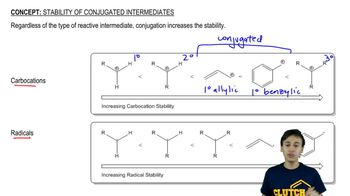
Stability of Conjugated Intermediates