

Ch.9 - Alkynes
Wade - Organic Chemistry 9th Edition
Wade9th EditionOrganic ChemistryISBN: 9780135213728당신이 사용하는 게 아니라요?교과서 변경
9장, 문제 8a

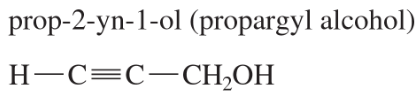
Show how you would synthesize each compound, beginning with acetylene and any necessary additional reagents
(a)

검증된 단계별 안내
1
Step 1: Begin with acetylene (H—C≡C—H) as the starting material. Acetylene is a terminal alkyne, which can undergo nucleophilic substitution reactions when treated with a strong base.
Step 2: Deprotonate acetylene using a strong base such as sodium amide (NaNH₂) to generate the acetylide ion (⁻C≡C—H). This ion is highly nucleophilic and can attack electrophiles.
Step 3: React the acetylide ion with formaldehyde (H₂C=O), which is an electrophilic carbonyl compound. This reaction proceeds via nucleophilic addition, where the acetylide ion attacks the carbonyl carbon of formaldehyde.
Step 4: After the nucleophilic addition, the intermediate formed is protonated using a mild acid (e.g., H₃O⁺) to yield the final product, prop-2-yn-1-ol (H—C≡C—CH₂OH).
Step 5: Verify the structure of the product to ensure it matches the desired compound, prop-2-yn-1-ol, which contains a terminal alkyne group and a hydroxymethyl (-CH₂OH) group.

비슷한 문제에 대한 검증된 영상 답변:

이 영상 해법은 위 문제에 도움이 된다고 튜터들이 추천한 것입니다.
영상 길이:
6m
도움이 되었나요?

주요 개념

질문에 올바르게 답하기 위해 반드시 이해해야 하는 핵심 개념들은 다음과 같습니다.

Acetylene as a Building Block

Acetylene (C2H2) is a simple alkyne that serves as a versatile building block in organic synthesis. Its triple bond allows for various reactions, including nucleophilic additions and coupling reactions. Understanding how to manipulate acetylene is crucial for constructing more complex molecules, such as propargyl alcohol.
추천 영상:
가이드 코스
16:59
Building a molecular sentence

Nucleophilic Addition Reactions

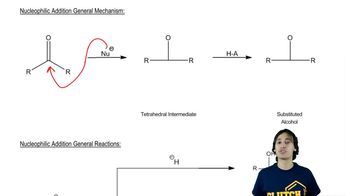
Nucleophilic addition reactions involve the attack of a nucleophile on an electrophilic carbon, often found in carbonyl compounds or alkynes. In the synthesis of propargyl alcohol, a nucleophile can add to the terminal carbon of acetylene, leading to the formation of alcohols. Mastery of these reactions is essential for building functionalized organic compounds.
추천 영상:
가이드 코스
08:27
Nucleophilic Addition

Functional Group Transformations

Functional group transformations are chemical reactions that convert one functional group into another, allowing for the modification of molecular structures. In synthesizing propargyl alcohol, the transformation of an alkyne to an alcohol involves specific reagents, such as water and a catalyst, to facilitate the addition of hydroxyl groups. Understanding these transformations is key to designing effective synthetic pathways.
추천 영상:
가이드 코스
02:36
Identifying Functional Groups