

Ch.9 - Alkynes
Wade - Organic Chemistry 9th Edition
Wade9th EditionOrganic ChemistryISBN: 9780135213728당신이 사용하는 게 아니라요?교과서 변경
9장, 문제 29g,h,i

Using hex-1-ene as your starting material, show how you would synthesize the following compounds. (Once you have shown how to synthesize a compound, you may use it as the starting material in any later parts of this problem.)
g. pentanoic acid
h. pentanal
i. undec-6-yn-5-ol

검증된 단계별 안내
1
Step 1: Begin with hex-1-ene as the starting material. To synthesize pentanoic acid (g), perform an ozonolysis reaction. Ozonolysis involves cleaving the double bond in hex-1-ene using ozone (O₃) followed by reductive workup with a reducing agent like zinc (Zn) and acetic acid or dimethyl sulfide (DMS). This will yield two products: pentanal and formaldehyde.
Step 2: To convert pentanal into pentanoic acid, perform an oxidation reaction. Use an oxidizing agent such as potassium permanganate (KMnO₄), chromium trioxide (CrO₃), or Jones reagent (H₂SO₄/CrO₃). This will oxidize the aldehyde group (-CHO) in pentanal to a carboxylic acid group (-COOH), forming pentanoic acid.
Step 3: To synthesize pentanal (h), you can directly use the pentanal obtained from the ozonolysis reaction in Step 1. No further modification is needed as pentanal is already formed during the cleavage of hex-1-ene.
Step 4: To synthesize undec-6-yn-5-ol (i), start with hex-1-ene and perform a hydroboration-oxidation reaction to convert the alkene into an alcohol. Use BH₃·THF (borane-tetrahydrofuran complex) followed by hydrogen peroxide (H₂O₂) and sodium hydroxide (NaOH) to yield hexan-1-ol. Then, perform a Williamson ether synthesis to elongate the chain using an appropriate alkyl halide to form undec-6-yn-5-ol.
Step 5: For the alkyne functionality in undec-6-yn-5-ol, introduce a terminal alkyne group by performing a dehydrohalogenation reaction. Use a strong base like sodium amide (NaNH₂) to eliminate halogens from a precursor molecule, ensuring the triple bond is formed at the desired position. Combine this with the alcohol group at position 5 to finalize the structure.

비슷한 문제에 대한 검증된 영상 답변:

이 영상 해법은 위 문제에 도움이 된다고 튜터들이 추천한 것입니다.
영상 길이:
18m
도움이 되었나요?

주요 개념

질문에 올바르게 답하기 위해 반드시 이해해야 하는 핵심 개념들은 다음과 같습니다.

Alkenes and Electrophilic Addition

Alkenes, such as hex-1-ene, are hydrocarbons that contain a carbon-carbon double bond. They undergo electrophilic addition reactions, where electrophiles attack the double bond, leading to the formation of more complex molecules. Understanding this reaction mechanism is crucial for synthesizing compounds from alkenes, as it allows for the introduction of functional groups that can be further transformed.
추천 영상:
09:23
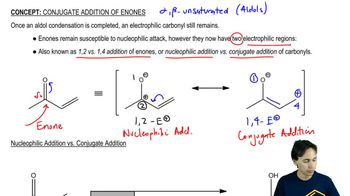
1,2 vs 1,4 Addition

Oxidation and Reduction Reactions

Oxidation and reduction reactions are fundamental in organic synthesis, involving the transfer of electrons between species. In the context of synthesizing pentanoic acid and pentanal, oxidation of alcohols or alkenes can convert them into carboxylic acids or aldehydes, respectively. Recognizing the appropriate oxidizing agents and conditions is essential for achieving the desired transformations.
추천 영상:
00:54
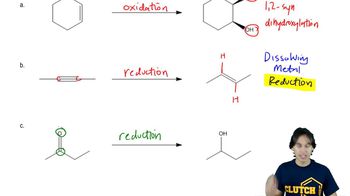
Distinguishing between Oxidation and Reduction

Functional Group Interconversion

Functional group interconversion refers to the process of transforming one functional group into another, which is vital in organic synthesis. For example, converting an alkene to an alcohol or a carboxylic acid involves specific reagents and reaction conditions. Mastery of these transformations allows chemists to build complex molecules from simpler starting materials, such as hex-1-ene.
추천 영상:
02:36
Identifying Functional Groups
관련 실천
교과서 질문

Using cyclooctyne as your starting material, show how you would synthesize the following compounds. (Once you have shown how to synthesize a compound, you may use it as the starting material in any later parts of this problem.)

(a) cis-cyclooctene

(b) cyclooctane

(c) trans-1,2-dibromocyclooctane

1164
views
교과서 질문

Using hex-1-ene as your starting material, show how you would synthesize the following compounds. (Once you have shown how to synthesize a compound, you may use it as the starting material in any later parts of this problem.)

d. hex-2-yne

e. hexan-2-one

f. hexanal

1317
views
교과서 질문

Using hex-1-ene as your starting material, show how you would synthesize the following compounds. (Once you have shown how to synthesize a compound, you may use it as the starting material in any later parts of this problem.)

a. 1,2-dibromohexane

b. hex-1-yne

c. 2,2-dibromohexane

1071
views
교과서 질문

Give IUPAC names for the following compounds.

(d)

(e)

(f)

2036
views
교과서 질문

Using cyclooctyne as your starting material, show how you would synthesize the following compounds. (Once you have shown how to synthesize a compound, you may use it as the starting material in any later parts of this problem.)

(h)

901
views
교과서 질문

Using cyclooctyne as your starting material, show how you would synthesize the following compounds. (Once you have shown how to synthesize a compound, you may use it as the starting material in any later parts of this problem.)

(g) cyclooctane-1,2-dione

841
views