Ch.6 - Alkyl Halides; Nucleophilic Substitution
Wade - Organic Chemistry 9th Edition
Wade9th EditionOrganic ChemistryISBN: 9780135213728당신이 사용하는 게 아니라요?교과서 변경
6장, 문제 41b(i,ii)

Allylic halides have the structure

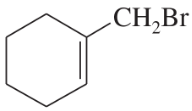
b. Draw the resonance structures of the allylic cations formed by ionization of the following halides.
(i)
(ii)

검증된 단계별 안내
1
Identify the allylic position in the given halides. The allylic position is the carbon atom adjacent to the carbon-carbon double bond.
For compound (i), remove the bromine atom to form a carbocation at the allylic position. This will result in a positive charge on the carbon atom adjacent to the double bond.
Draw the first resonance structure for compound (i) by moving the pi electrons from the double bond to form a new double bond with the carbocation, shifting the positive charge to the other end of the original double bond.
For compound (ii), similarly, remove the bromine atom to form a carbocation at the allylic position, resulting in a positive charge on the carbon atom adjacent to the double bond.
Draw the first resonance structure for compound (ii) by moving the pi electrons from the double bond to form a new double bond with the carbocation, shifting the positive charge to the other end of the original double bond.

비슷한 문제에 대한 검증된 영상 답변:

이 영상 해법은 위 문제에 도움이 된다고 튜터들이 추천한 것입니다.
영상 길이:
5m
도움이 되었나요?

주요 개념

질문에 올바르게 답하기 위해 반드시 이해해야 하는 핵심 개념들은 다음과 같습니다.

Allylic Halides

Allylic halides are organic compounds where a halogen atom is bonded to a carbon atom adjacent to a carbon-carbon double bond. This structure allows for unique reactivity due to the presence of the double bond, which can stabilize intermediates through resonance. The allylic position is particularly reactive in substitution and elimination reactions.
추천 영상:
01:52
How to name alkyl halides

Resonance Structures

Resonance structures are different Lewis structures for a molecule that depict the same arrangement of atoms but differ in the distribution of electrons. They are used to represent the delocalization of electrons within a molecule, which can stabilize charged intermediates like allylic cations. Resonance structures are crucial for understanding the stability and reactivity of organic compounds.
추천 영상:
03:04
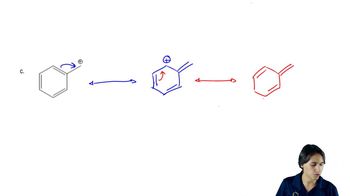
Drawing Resonance Structures

Allylic Cations

Allylic cations are positively charged intermediates formed when a halide ion leaves an allylic halide, resulting in a carbocation at the allylic position. These cations are stabilized by resonance, as the positive charge can be delocalized over the adjacent double bond. This delocalization makes allylic cations more stable than typical carbocations, influencing their reactivity in chemical reactions.
추천 영상:
가이드 코스
0:52
Cationic Polymerization Concept 3